Polymorphism: dynamic dispatch and toString()
Handout
This page needs a recent browser (with SharedArrayBuffer support). Please update Chrome, Edge, Firefox or Safari to the latest version.
Polymorphism: one type, many behaviours
- Polymorphism means "many forms": one superclass type, many subclass behaviours.
- You can hold a
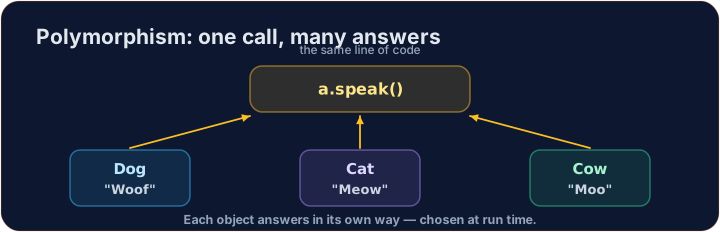
Dogor aCatin anAnimalvariable, because each is-anAnimal. - When you call a method, the object's real type decides which version runs.
Dynamic dispatch
- The variable's type (
Animal) decides which methods you are allowed to call. - But at run time, the actual object (
Dog) decides which overridden version runs. - This run-time choice is called dynamic dispatch — it is the heart of polymorphism.
public class Main {
    public static void main(String[] args) {
        Animal[] zoo = { new Dog(), new Cat(), new Dog() };
        for (Animal a : zoo) {
            System.out.println(a.speak());   // Woof, then Meow, then Woof
        }
    }
}

class Animal {
    public String speak() { return "some sound"; }
}
class Dog extends Animal {
    public String speak() { return "Woof"; }
}
class Cat extends Animal {
    public String speak() { return "Meow"; }
}
One loop handles every subclass
- The loop above never asks "is this a Dog or a Cat?" — it just calls
speak(). - Each object answers in its own way. That keeps the loop short and general.
- Add a brand-new subclass later and the same loop works on it, unchanged.
toString(): every object inherits it from Object
- Every class in Java secretly extends a class called
Object, which has atoString(). - Override
toString()to say how your object should look as text. - Java calls it automatically when you print an object or join it with
+.
public class Main {
    public static void main(String[] args) {
        Object x = new Fraction(3, 4);
        System.out.println(x);              // 3/4   -- toString() runs
        System.out.println("ratio " + x);   // ratio 3/4
    }
}

class Fraction {
    private int numerator;
    private int denominator;
    public Fraction(int numerator, int denominator) {
        this.numerator = numerator;
        this.denominator = denominator;
    }
    public String toString() {
        return numerator + "/" + denominator;
    }
}
Common mistakes
- The actual object's method runs at run time (dynamic dispatch), not the variable's type.
- Override
toString()for readable output.
Now you try
- Use a superclass array, add a new subclass, and override
toString(). - A hidden Harness checks that the right version runs for each object.
- Press Run to compile, then Check answer. Your code runs on the server, so even the first run is fast.
Animal, Dog, and Cat are written for you. Complete the static method Zoo.chorus(Animal[] animals) so it returns every animal's sound joined by single spaces. Example: a Dog, Cat, Dog array gives "Woof Meow Woof". An empty array gives "". Loop and call speak() — let polymorphism pick the right sound.
Click Run to see the output here.
Animal, Dog, Cat, and a working Zoo.chorus are written for you. Add a class Cow that extends Animal and overrides speak() to return "Moo". Notice the existing chorus loop handles your new Cow with no changes.
Click Run to see the output here.
Complete Fraction by overriding toString() so it returns the fraction as "numerator/denominator" — for 3 and 4 it returns "3/4". Java calls toString() automatically when you print a Fraction or join it with +.
Click Run to see the output here.