Impact of computing
HandoutComputing changes the world
- Computing affects almost every part of life: school, work, health, money, and friends.
- The same tool can bring benefits (good effects) and harms (bad effects).
- A good computer scientist thinks about both sides, not just the cool features.
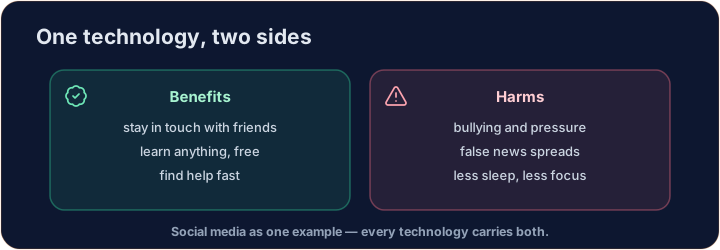
One technology, two sides:

  Social media
    Benefit: stay in touch, share, learn
    Harm:    bullying, false news, less sleep
Benefits and harms together
- A benefit for one group can be a harm for another.
- Example: an app that suggests videos keeps you watching (benefit for the company) but can waste your time (harm for you).
- Always ask: who gains, who loses, and what could go wrong?
The digital divide
- The digital divide is the gap between people who have good access to computing and those who do not.
- Causes include money, where you live (no fast Internet), and not having training.
- This is unfair: people without access miss out on school, jobs, and information.
Bias in computing
- Bias means an unfair result that favors one group over another.
- Software learns from data. If the data is unfair or incomplete, the results can be unfair too.
- Example: a face tool trained mostly on one kind of face may work badly for other people.
Biased data  ->  biased results

  Training data:  mostly group A faces
  Result:         works well for A, poorly for B
Intellectual property and licensing
- Intellectual property (IP) is creative work people make: code, music, art, writing.
- A license is the rules for how others may use that work. Using work without permission can break the law.
- Open source software shares its code so others may read and reuse it; Creative Commons licenses let creators say "you may share this, with these conditions".
Privacy and PII
- PII means Personally Identifiable Information: data that points to a real person.
- Examples: full name, home address, phone number, ID number, exact location.
- Once data is online it is hard to take back, and apps may collect more than you expect. Share carefully.
Safe computing
- Use a strong, unique password for important accounts (long, mixed, not reused).
- Watch out for phishing: fake messages that trick you into giving passwords or money. Check the sender; do not click strange links.
- Keep software updated, and think before you post personal data.
Key words
- Digital divide: the gap in access to computing.
- Bias: an unfair result, often from unfair data.
- Intellectual property / license: who owns creative work and how it may be used.
- PII / privacy: personal data, and protecting it.
- Phishing: fake messages that try to steal your information.
Common mistakes
- Weigh both the benefits and the harms (bias, privacy, unequal access).
- The digital divide is the gap in access to technology.
Now you try
- These tasks turn the ideas above into code: PII, bias, and password safety.
- Press Check answer to test your code.
PII is data that points to a real person. You are given a record fields (a dict like {"name": ..., "color": ..., "phone": ...}) and a set pii_names of PII field names. Write count_pii(fields, pii_names) that returns how many of the record's keys are PII.
Click Run to see the output here.
Software can be biased if it works better for one group than another. Write accuracy_gap(correct_a, total_a, correct_b, total_b) that returns group A's accuracy minus group B's accuracy, as a decimal. Example: accuracy_gap(90, 100, 60, 100) is 0.3.
Click Run to see the output here.
A password is strong when it is at least 12 characters and is not in the list of common passwords. Write is_strong(password, common) returning True or False. Example: with common = ["password", "123456"], is_strong("correcthorsebattery", common) is True.
Click Run to see the output here.