Symmetric encryption
This page needs a recent browser (with SharedArrayBuffer support). Please update Chrome, Edge, Firefox or Safari to the latest version.
Locking with a key
- Encryption scrambles a message so only someone with the key can read it.
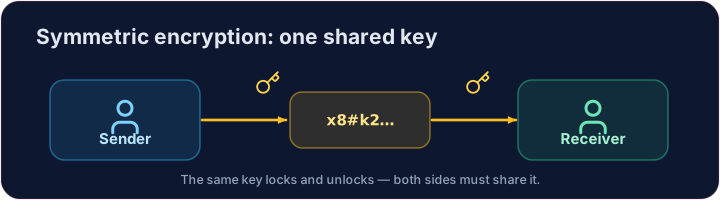
- In symmetric encryption, the same key locks and unlocks. Sender and receiver must both know it.
The Caesar cipher
- The oldest example: shift every letter forward by a fixed number. With shift 3,
a → d,b → e, and so on. - The key is the shift. Decrypting just shifts back.
text = "attack"
shift = 3
out = "".join(chr((ord(c) - 97 + shift) % 26 + 97) for c in text)
print(out)        # dwwdfn
Why Caesar is weak
- There are only 25 possible shifts, so a computer can try them all in a blink.
- This is a brute-force attack on the key — exactly what real encryption must resist.
What real ciphers do
- Modern symmetric ciphers like AES use keys with billions of billions of possibilities.
- The big problem they leave: how do two people share the secret key safely? The next lesson solves it.
Covers: IGCSE 2.3 (symmetric encryption), A-Level 17.1.
Common mistakes
- One shared key both encrypts and decrypts.
- The hard part is sharing that key safely.
Explore
Symmetric encryption
The Caesar cipher uses one shared key to encrypt and decrypt.
Encrypt hello with a Caesar cipher: shift each letter forward by shift places (wrapping past z back to a). Build the encrypted string and print it.
Click Run to see the output here.
Now break it — that is why Caesar is weak. You intercepted cipher, and you suspect the plaintext is attack. Try every shift from 1 to 25, shifting back, and print the shift that turns cipher into attack.
Click Run to see the output here.