| Candidates should be able to: | Notes and guidance |
|---|---|
| Show understanding of the limitations of using a file-based approach for the storage and retrieval of data | |
| Describe the features of a relational database that address the limitations of a file-based approach | |
| Show understanding of and use the terminology associated with a relational database model | Including entity, table, record, field, tuple, attribute, primary key, candidate key, secondary key, foreign key, relationship (one-to-many, one-to-one, many-to-many), referential integrity, indexing |
| Use an entity-relationship (E-R) diagram to document a database design | |
| Show understanding of the normalisation process | First Normal Form (1NF), Second Normal Form (2NF) and Third Normal Form (3NF) |
| Explain why a given set of database tables are, or are not, in 3NF | |
| Produce a normalised database design for a description of a database, a given set of data, or a given set of tables |
Databases
A-Level Computer Science · Topic 8
8.1
File-based storage and its limits

Syllabus
Source: Cambridge International syllabus
Before databases, programs stored data in flat files 平面文件 — usually one file per program. This is fine for small data but breaks down at scale.
Limitations
- data redundancy 数据冗余 — the same data (a customer's address) is held in several files.
- data inconsistency 数据不一致 — redundant copies updated separately get out of sync.
- data dependence — programs are tied to the file format; change the format and every program must be rewritten.
- hard to enforce integrity 完整性, hard to share safely, weak querying, and weak per-field security.


A relational database 关系数据库 fixes these by storing data in tables managed by one piece of software (the DBMS) that all programs use.

Vocabulary
Train
| English | Chinese | Pinyin |
|---|---|---|
| flat files | 平面文件 | píng miàn wén jiàn |
| data redundancy | 数据冗余 | shù jù rǒng yú |
| data inconsistency | 数据不一致 | shù jù bù yī zhì |
| integrity | 完整性 | wán zhěng xìng |
| relational database | 关系数据库 | guān xì shù jù kù |
8.1
Relational model — terms

- table 表 (relation) — a grid of rows and columns; one table per type of entity 实体 (e.g.
CUSTOMER). - record 记录 (row, also called a tuple 元组) — one row; one instance of the entity.
- field 字段 (column, also called an attribute 属性) — one column; one piece of information about each record.
- primary key 主键 — a field (or fields) that uniquely identifies each record; never null or duplicated.
- foreign key 外键 — a field whose value matches the primary key of another table, linking the two.
- composite key 复合键 — a primary key made of two or more fields together.
- candidate key 候选键 — any field(s) that could be the primary key.
- secondary key 次键 — a non-primary field that is indexed for fast searching.
- indexing 索引 — building an index on a field so look-ups and joins run faster.
- referential integrity 参照完整性 — every foreign-key value must match an existing primary key (no orphan records).
A table is written in shorthand with the primary key underlined and foreign keys noted:
CUSTOMER(CustomerID, Name, Phone)
ORDER(OrderID, CustomerID, OrderDate)   -- CustomerID is FK → CUSTOMER
Explore
Read a relational table with SELECT
A relational table is just rows (records) and columns (fields). WHERE keeps the rows that match a condition; SELECT then keeps only the columns you asked for.
Vocabulary
Train
| English | Chinese | Pinyin |
|---|---|---|
| table | 表 | biǎo |
| entity | 实体 | shí tǐ |
| record | 记录 | jì lù |
| field | 字段 | zì duàn |
| primary key | 主键 | zhǔ jiàn |
| foreign key | 外键 | wài jiàn |
| composite key | 复合键 | fù hé jiàn |
| candidate key | 候选键 | hòu xuǎn jiàn |
| referential integrity | 参照完整性 | cān zhào wán zhěng xìng |
| tuple | 元组 | yuán zǔ |
| attribute | 属性 | shǔ xìng |
| secondary key | 次键 | cì jiàn |
| indexing | 索引 | suǒ yǐn |
8.1
Entity-relationship (E-R) diagrams
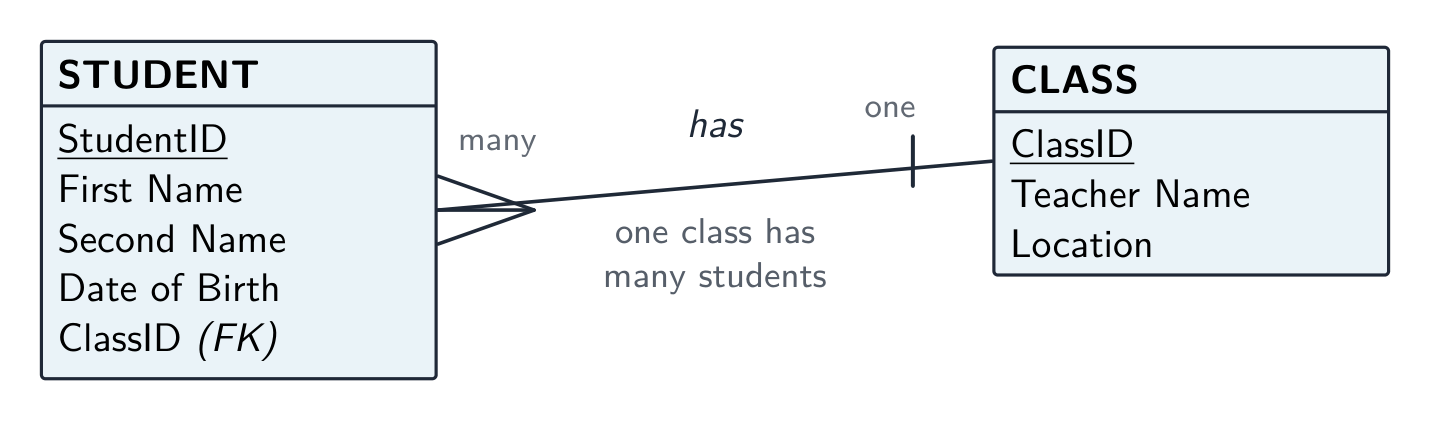
An entity-relationship diagram 实体关系图 shows the structure: each entity is a rectangle, each relationship a line, with the cardinality 基数 marked at each end:
- one-to-one (1:1).
- one-to-many 一对多 (1:M) — each Customer has many Orders; each Order has one Customer.
- many-to-many (M:N) — Students take many Courses, and Courses have many Students.

A many-to-many relationship cannot be stored directly. Break it into two one-to-many relationships through a link table 连接表 holding the two foreign keys:
ENROLMENT(StudentID, CourseID, EnrolmentDate)

Vocabulary
Train
| English | Chinese | Pinyin |
|---|---|---|
| entity-relationship diagram | 实体关系图 | shí tǐ guān xì tú |
| cardinality | 基数 | jī shù |
| one-to-many | 一对多 | yī duì duō |
| link table | 连接表 | lián jiē biǎo |
8.1
Normalisation

Normalisation 规范化 organises tables to cut redundancy and inconsistency, going through normal forms 范式 in order.
- First normal form (1NF) — every field holds a single (atomic 原子) value, with no repeating groups, and a primary key.
- Second normal form (2NF) — in 1NF, and every non-key field depends on the whole primary key (only matters for a composite key).
- Third normal form (3NF) — in 2NF, and every non-key field depends only on the primary key, not on another non-key field (no transitive dependency 传递依赖).
A 3NF design stores each fact once, so insert/update/delete anomalies disappear. The trade-off is more tables and more joins. Aim for 3NF.
To produce a 3NF design: find the entities and their attributes; choose a primary key for each; split repeating/non-atomic fields (1NF); split fields depending on part of a composite key (2NF); split fields depending transitively on the key (3NF); add foreign keys for the relationships.
Worked example. The table ORDER(OrderID, CustomerID, CustomerName, ProductID, Quantity) has the composite primary key (OrderID, ProductID). Normalise it to 3NF. Test each non-key field against the key. Quantity depends on both OrderID and ProductID, which is fine. But CustomerID depends on OrderID alone - only part of the composite key. That is a partial dependency, so the table is not in 2NF. Split it into ORDER_LINE(OrderID, ProductID, Quantity) and ORDER(OrderID, CustomerID, CustomerName). Now test 3NF: in that new ORDER table, CustomerName depends on CustomerID, which is not the key - a transitive dependency. Split again: ORDER(OrderID, CustomerID) and CUSTOMER(CustomerID, CustomerName). Name the dependency that breaks each form (partial breaks 2NF, transitive breaks 3NF); "it has repeated data" describes the symptom and earns nothing.
Vocabulary
Train
| English | Chinese | Pinyin |
|---|---|---|
| normalisation | 规范化 | guī fàn huà |
| normal forms | 范式 | fàn shì |
| atomic | 原子 | yuán zi |
| transitive dependency | 传递依赖 | chuán dì yī lài |
8.2
Database Management System (DBMS)
Syllabus
| Candidates should be able to: | Notes and guidance |
|---|---|
| Show understanding of the features provided by a Database Management System (DBMS) that address the issues of a file based approach | Including: • data management, including maintaining a data dictionary • data modelling • logical schema • data integrity • data security, including backup procedures and the use of access rights to individuals / groups of users |
| Show understanding of how software tools found within a DBMS are used in practice | Including the use and purpose of: • developer interface • query processor |
Source: Cambridge International syllabus
A DBMS 数据库管理系统 manages the database centrally. Features that fix the file-based limits:
- data dictionary 数据字典 — a description of every table, field, type and key; programs query it instead of hard-coding the structure.
- redundancy/consistency control — each fact stored once.
- concurrent access 并发访问 control — locks and transactions let many users work at once.
- backup 备份 and recovery; security and per-user permissions.
- integrity rules — keys, unique and range constraints, enforced centrally.
- transactions 事务 — a group of operations that all succeed or all fail.
- views 视图 — virtual tables that show each user "their" slice of the data.
- data management 数据管理 and data modelling 数据建模 — control how data is stored and define its structure as a logical schema 逻辑模式 (the logical design, independent of physical storage).
- data integrity 数据完整性 and data security 数据安全 — enforce correctness and control access centrally.
- a query processor 查询处理器 runs queries; a developer interface 开发者接口 gives tools and APIs for building applications.
Its tools include a data-dictionary editor, a query builder, a forms builder, a report generator, user management, and an SQL editor.
Explore
Database service lab
Watch how a DBMS turns a query into safe shared data access.
Explore
Database service lab
Watch how a DBMS turns a query into safe shared data access.
Vocabulary
Train
| English | Chinese | Pinyin |
|---|---|---|
| DBMS | 数据库管理系统 | shù jù kù guǎn lǐ xì tǒng |
| data dictionary | 数据字典 | shù jù zì diǎn |
| concurrent access | 并发访问 | bìng fā fǎng wèn |
| backup | 备份 | bèi fèn |
| transactions | 事务 | shì wù |
| views | 视图 | shì tú |
| data management | 数据管理 | shù jù guǎn lǐ |
| data modelling | 数据建模 | shù jù jiàn mó |
| logical schema | 逻辑模式 | luó jí mó shì |
| data integrity | 数据完整性 | shù jù wán zhěng xìng |
| data security | 数据安全 | shù jù ān quán |
| query processor | 查询处理器 | chá xún chǔ lǐ qì |
| developer interface | 开发者接口 | kāi fā zhě jiē kǒu |
8.3
DDL and DML

Syllabus
| Candidates should be able to: | Notes and guidance |
|---|---|
| Show understanding that the DBMS carries out all creation/modification of the database structure using its Data Definition Language (DDL) | |
| Show understanding that the DBMS carries out all queries and maintenance of data using its DML | |
| Show understanding that the industry standard for both DDL and DML is Structured Query Language (SQL) | Understand a given SQL statement |
| Understand given SQL (DDL) statements and be able to write simple SQL (DDL) statements using a sub-set of statements | Create a database (CREATE DATABASE) Create a table definition (CREATE TABLE), including the creation of attributes with appropriate data types: • CHARACTER • VARCHAR(n) • BOOLEAN • INTEGER • REAL • DATE • TIME change a table definition (ALTER TABLE) add a primary key to a table (PRIMARY KEY (field)) add a foreign key to a table (FOREIGN KEY (field) REFERENCES Table (Field)) |
| Write an SQL script to query or modify data (DML) which are stored in (at most two) database tables | Queries including SELECT... FROM, WHERE, ORDER BY, GROUP BY, INNER JOIN, SUM, COUNT, AVG |
| Data maintenance including INSERT INTO, DELETE FROM, UPDATE |
Source: Cambridge International syllabus
SQL 结构化查询语言 (Structured Query Language) has two halves:
- Data Definition Language 数据定义语言 (DDL) — creates or changes the structure (tables, keys, constraints).
- Data Manipulation Language 数据操纵语言 (DML) — works with the data (insert, update, delete, query 查询).
DDL basics
CREATE TABLE CUSTOMER (
  CustomerID INTEGER PRIMARY KEY,
  Name VARCHAR(50) NOT NULL,
  Phone VARCHAR(20)
);
Add a foreign key:
CREATE TABLE ORDER (
  OrderID INTEGER PRIMARY KEY,
  CustomerID INTEGER,
  OrderDate DATE,
  FOREIGN KEY (CustomerID) REFERENCES CUSTOMER(CustomerID)
);
Modify and drop:
ALTER TABLE CUSTOMER ADD Email VARCHAR(100);
DROP TABLE CUSTOMER;
Common types: INTEGER, REAL, VARCHAR(n), CHAR(n) (also CHARACTER(n)), DATE, TIME, BOOLEAN, DECIMAL(p, s).
DML basics
Query with SELECT:

SELECT Name, Phone
FROM CUSTOMER
WHERE City = 'London'
ORDER BY Name ASC;
SELECT lists fields, FROM names the table, WHERE filters rows, ORDER BY sorts.
A join 连接 combines two tables using a foreign-key relationship:
SELECT C.Name, O.OrderDate
FROM CUSTOMER C INNER JOIN ORDER O
  ON C.CustomerID = O.CustomerID
WHERE O.OrderDate >= '2024-01-01';
Aggregate functions 聚合函数 (COUNT, SUM, AVG, MIN, MAX) are often used with GROUP BY:
SELECT CustomerID, COUNT(*) AS NumOrders
FROM ORDER
GROUP BY CustomerID;
Insert, update, delete:
INSERT INTO CUSTOMER (CustomerID, Name, Phone)
VALUES (101, 'Ada Lovelace', '020-1234-5678');

UPDATE CUSTOMER SET Phone = '020-9999-0000' WHERE CustomerID = 101;

DELETE FROM CUSTOMER WHERE CustomerID = 101;
Always put a WHERE clause on UPDATE and DELETE, or the change hits every row.
Tips for exam SQL
- use the exact table and field names from the question.
- quote strings with single quotes (
'Smith'); don't quote numbers. - comparisons:
=,<,>,<=,>=,<>. LIKE 'A%'matches anything starting with A (%= any string,_= one character);IN (1,2,3);BETWEEN 10 AND 20.- combine conditions with
AND/OR/NOT, and end each statement with a semicolon.
Explore
Stitch two tables with INNER JOIN
A join matches rows where the foreign key equals the primary key — here Orders.CustomerID = Customer.CustomerID — and combines each matching pair into one wider row.
Explore
SELECT … WHERE
Step through a query: WHERE keeps the rows that match, then SELECT picks the columns you asked for.
Vocabulary
Train
| English | Chinese | Pinyin |
|---|---|---|
| SQL | 结构化查询语言 | jié gòu huà chá xún yǔ yán |
| Data Definition Language | 数据定义语言 | shù jù dìng yì yǔ yán |
| Data Manipulation Language | 数据操纵语言 | shù jù cāo zòng yǔ yán |
| query | 查询 | chá xún |
| join | 连接 | lián jiē |
| aggregate functions | 聚合函数 | jù hé hán shù |
8.3
Exam tips
- Define the terms exactly: entity, attribute, primary key, foreign key, and the relationship types (1:1, 1:many, many:many).
- Give a reason at each normal form: 1NF (no repeating groups), 2NF (no partial dependency), 3NF (no non-key dependency).
- Explain what a DBMS provides (data independence, security, integrity, concurrent access).
- Distinguish DDL (define the structure) from DML (query and change the data).