- understand the economic problem: finite (scarce) resources and unlimited wants
- distinguish economic goods (scarce, have an opportunity cost) and free goods
- understand that the economic problem forces consumers, workers, producers and governments to make choices
IGCSE Economics
-
1 The basic economic problem
1.1
The economic problem

Syllabus
Source: Cambridge International syllabus
Economics is about how people use resources 资源 to meet their needs and wants. The main idea is simple. People want a lot, but there are not enough resources to make everything. This is the economic problem 经济问题.
Two facts cause the economic problem:
- Resources are finite 有限的. There is only a limited amount of them.
- People's wants 欲望 are unlimited. People always want more and better things.
Because wants are unlimited but resources are limited, resources are scarce 稀缺. We call this problem scarcity 稀缺性. Scarcity is the root of all economics.
The economic problem: scarcity forces choice, and every choice has an opportunity cost Goods, services, and choices
We use resources to make goods 物品 (things you can touch, like food and phones) and services 服务 (jobs done for you, like a haircut or a bus ride).
Because resources are scarce, we cannot have everything. So everyone must make choices. Scarcity forces four groups to choose:
- consumers 消费者 — people who buy and use goods and services. They choose what to buy.
- workers 工人 — they choose which job to do.
- producers 生产者, also called firms 企业 — they make goods and services. They choose what to produce.
- governments 政府 — they choose what to provide and how to spend public money.
Economic goods and free goods
Most things are economic goods 经济物品. They are scarce, so making or using one means giving something else up. Economic goods have an opportunity cost 机会成本 (explained below).
A few things are free goods 免费物品. They are not scarce — there is enough for everyone and they cost nothing to use. Examples are the air you breathe and sunlight. A free good has no opportunity cost.
Be careful: a "free" sample or a "free" gift is not a free good. Resources were used to make it, so it is still an economic good.
ExploreScarcity and choice
Limited resources mean producing more of one good costs some of the other — the opportunity cost, shown by the frontier.
Vocabulary TrainEnglish Chinese Pinyin resources 资源 zī yuán economic problem 经济问题 jīng jì wèn tí finite 有限的 yǒu xiàn de wants 欲望 yù wàng scarce 稀缺 xī quē scarcity 稀缺性 xī quē xìng goods 物品 wù pǐn services 服务 fú wù consumers 消费者 xiāo fèi zhě workers 工人 gōng rén producers 生产者 shēng chǎn zhě firms 企业 qǐ yè governments 政府 zhèng fǔ economic goods 经济物品 jīng jì wù pǐn opportunity cost 机会成本 jī huì chéng běn free goods 免费物品 miǎn fèi wù pǐn 1.2
Factors of production

Syllabus
- define the four factors of production: land, labour, capital and enterprise, with examples
- state the reward to each factor (rent, wages, interest, profit)
- explain the mobility of the factors of production and the causes of changes in their quantity and quality
Source: Cambridge International syllabus
To make goods and services, firms use four types of resource. We call them the factors of production 生产要素.
The four factors of production and the reward each one earns The four factors
Factor What it is Example land 土地 natural resources fields, water, oil, forests labour 劳动 human work a teacher, a builder, a nurse capital 资本 man-made things used to produce machines, tools, factories enterprise 企业家才能 organising the other three and taking risks a person who starts a business The person who provides enterprise is the entrepreneur 企业家. They bring the other factors together and risk their own money to start and run a business.

Land — natural resources such as farmland — is one of the four factors of production The reward to each factor
Each factor earns a reward 报酬 — the income it gets for being used:
Factor Reward land rent 地租 labour wages 工资 capital interest 利息 enterprise profit 利润 Mobility, quantity and quality
The mobility 流动性 of a factor means how easily it can move to a different use or place. A worker with many skills can change jobs easily, so labour is mobile. A worker with only one skill, or a factory that cannot be moved, is less mobile.
The quantity and quality of factors can change:
- Quantity can rise or fall. The amount of labour grows if the birth rate rises or people move into the country to work. Land can be lost to the sea or gained by draining it.
- Quality can rise. Training and education make labour better. New technology makes capital better. Higher quality means each factor can produce more.
ExploreFactors of production lab
Sort real resources by the factor of production they represent.
Vocabulary TrainEnglish Chinese Pinyin factors of production 生产要素 shēng chǎn yào sù land 土地 tǔ dì labour 劳动 láo dòng capital 资本 zī běn enterprise 企业家才能 qǐ yè jiā cái néng entrepreneur 企业家 qǐ yè jiā reward 报酬 bào chóu rent 地租 dì zū wages 工资 gōng zī interest 利息 lì xī profit 利润 lì rùn mobility 流动性 liú dòng xìng 1.3
Opportunity cost

Syllabus
- define opportunity cost as the next best alternative given up when a choice is made
- explain how opportunity cost influences decisions made by consumers, workers, producers and governments
Source: Cambridge International syllabus
The PPF and opportunity cost Consumers choosing what to buy at a busy market — scarcity forces everyone to make choices 
Choosing one thing means giving up the next best alternative When you choose one thing, you give up the next best choice. That is the real cost of your decision.
Opportunity cost is the next best alternative 替代选择 you give up when you make a choice.
It affects every decision-maker:
- A consumer who buys a game gives up the book they could have bought instead.
- A worker who takes one job gives up the pay of the next job they could have done.
- A producer who makes more cars uses factors that could have made trucks.
- A government that builds a hospital gives up the school it could have built with the same money.
Opportunity cost matters because resources are scarce. Every choice has a cost, even when no money changes hands.
ExploreOpportunity cost on the frontier
Moving along the frontier, gaining more of one good always means giving up some of the other — that sacrifice is the opportunity cost.
Vocabulary TrainEnglish Chinese Pinyin alternative 替代选择 tì dài xuǎn zé 1.4
Production possibility curve (PPC) diagrams

Syllabus
- draw and interpret a PPC showing the maximum combinations of two goods that can be produced
- explain points on, inside and outside the curve and movements along the curve (opportunity cost)
- explain causes of shifts in the PPC (changes in the quantity/quality of resources, economic growth or decline)
Source: Cambridge International syllabus
A production possibility curve 生产可能性曲线 (PPC) shows the largest amounts of two goods a country can make when it uses all its resources fully.
Imagine an economy that makes only two types of good, one on each axis:
- capital goods — used to make other goods, like machines.
- consumer goods — used up by people, like food and clothes.
The PPC is the line joining every point where the economy uses all its resources to make the most it can.
Reading the diagram
Picture the two goods on the two axes. The PPC is a curve that bends from one axis down to the other (it usually bows outward, away from the corner):
- A point on the curve: all resources are used fully. The economy makes the most it can.
- A point inside the curve: resources are wasted or not all used — for example, there is unemployment 失业. The economy could make more.
- A point outside the curve: this is impossible now. There are not enough resources to reach it.
A point on the curve uses all resources; inside the curve some are wasted (e.g. unemployment); outside is not possible with today's resources. Movements along the curve
If the economy already uses all its resources (a point on the curve), making more of one good means making less of the other. You must move factors from one good to the other. This is a trade-off 取舍.
The amount of the second good you give up is the opportunity cost of the extra first good. This is why the PPC is a clear picture of opportunity cost.
Worked example. An economy on its PPC makes 40 machines and 60 tonnes of food. To make 50 machines it must cut food to 45 tonnes. Give the opportunity cost of the extra machines. Then say what a point of 30 machines and 40 tonnes of food would tell you. The economy is already on the curve, so more of one good must mean less of the other: the 10 extra machines cost 60 − 45 = 15 tonnes of food. That lost food is the opportunity cost, so quote it in tonnes of food - never in money. The second point lies inside the curve, which means resources are idle or wasted, most likely through unemployment; from there the economy could make more of both goods, so moving out to the curve costs nothing at all. Opportunity cost only bites once you are on the curve.
Shifts of the curve
The whole curve can move:
- It shifts outward (to the right) when the country can make more of both goods. This is economic growth 经济增长. Causes: more resources (a bigger workforce, more land discovered) or better-quality resources (training, new technology).
- It shifts inward (to the left) when the country can make less. This is economic decline 经济衰退. Causes: fewer or worse resources — for example a war, a natural disaster, or using up non-renewable resources 不可再生资源 (resources like oil and coal that cannot be replaced once used).

More or better resources shift the whole PPC outward (growth); a war, disaster or using up resources shifts it inward (decline). Do not confuse the two. Moving from inside the curve to the curve (by using idle resources) is a short-term gain. Moving the whole curve outward is a long-term change.
ExploreThe production possibility curve
Move along the curve: making more of one good means making less of the other — that's opportunity cost.
Vocabulary TrainEnglish Chinese Pinyin production possibility curve 生产可能性曲线 shēng chǎn kě néng xìng qū xiàn unemployment 失业 shī yè trade-off 取舍 qǔ shě economic growth 经济增长 jīng jì zēng zhǎng economic decline 经济衰退 jīng jì shuāi tuì non-renewable resources 不可再生资源 bù kě zài shēng zī yuán 1.4
Exam tips
- Scarcity (unlimited wants, limited resources) forces choice, and every choice has an opportunity cost — the next best alternative you give up.
- Learn the four factors of production and the reward each earns: land–rent, labour–wages, capital–interest, enterprise–profit.
- On a PPC, a point on the curve uses all resources fully, inside wastes some (e.g. unemployment), and outside is impossible for now. Moving along the curve shows opportunity cost.
- Moving to the curve (using idle resources) is a short-term gain; shifting the whole curve outward is long-term economic growth from more or better resources.
-
2 The allocation of resources
2.1
Markets and the price mechanism

Syllabus
- define microeconomics and macroeconomics
- explain how the market (price mechanism) allocates resources through the signalling, incentive and rationing functions of price
Source: Cambridge International syllabus
Economics is split into two parts:
- microeconomics 微观经济学 — the study of single parts of the economy, such as one industry or one product.
- macroeconomics 宏观经济学 — the study of the whole economy, like total jobs, prices, and growth.
A market 市场 is any place or system where buyers and sellers meet to trade. It does not need a building — it can be online or over the phone.
A stock exchange is a market: as buyers and sellers trade, their offers set the price of each share When a market is free, no one is in charge of deciding what to make. Instead, the price mechanism 价格机制 (the free movement of prices) allocates 配置 resources 资源 — it decides what is made, how, and for whom. Price does three jobs:
- the signalling 信号 function — a price change tells buyers and sellers what is happening. A rising price signals "make more"; a falling price signals "make less".
- the incentive 激励 function — a higher price gives firms 企业 a reason to produce more, because they can earn more.
- the rationing 配给 function — when a product is scarce, its price rises. The high price shares out the limited amount to those willing to pay.
ExploreHow markets allocate resources
Price moves to where demand meets supply. That equilibrium price signals firms what to produce and rations goods to buyers.
Vocabulary TrainEnglish Chinese Pinyin microeconomics 微观经济学 wēi guān jīng jì xué macroeconomics 宏观经济学 hóng guān jīng jì xué market 市场 shì chǎng price mechanism 价格机制 jià gé jī zhì allocate 配置 pèi zhì resources 资源 zī yuán signalling 信号 xìn hào incentive 激励 jī lì firms 企业 qǐ yè rationing 配给 pèi jǐ 2.2
Demand

Syllabus
- define demand and explain the law of demand (inverse relationship with price), ceteris paribus
- draw demand curves and distinguish a movement along (change in price) from a shift (change in conditions of demand)
- list the conditions of demand (income, tastes, price of substitutes and complements, population, advertising)
Source: Cambridge International syllabus
Demand 需求 is the amount of a good 物品 that consumers 消费者 (buyers) are willing and able to buy at each price, in a period of time.
The law of demand 需求定律 says: when the price of a good rises, the quantity demanded falls; when the price falls, the quantity demanded rises. Price and quantity move in opposite directions — an inverse relationship 反向关系. This is true ceteris paribus 其他条件不变 (a Latin phrase meaning "all other things stay the same").
Movements and shifts
It helps to separate two ideas:
- quantity demanded 需求量 — the amount bought at one price.
- demand — the whole pattern of buying at every price.
On a demand diagram, price is on the up axis and quantity on the across axis. The demand curve 需求曲线 slopes downward from left to right: high price, low quantity; low price, high quantity.
- A change in the good's own price causes a movement along the demand curve. You slide to a new point on the same line.
- A change in any other condition causes a shift 移动 of the whole curve. A rightward shift means more is demanded at every price; a leftward shift means less.
Conditions of demand
These are the things (other than the good's own price) that shift the demand curve:
- income 收入 — more income usually means more demand.
- tastes 偏好 — if a good becomes popular, demand rises.
- price of substitutes 替代品 — goods used instead of each other (tea and coffee). If coffee gets dearer, demand for tea rises.
- price of complements 互补品 — goods used together (cars and fuel). If cars get dearer, demand for fuel falls.
- population 人口 — more people means more demand.
- advertising 广告 — good adverts raise demand.
The demand curve slopes down. A change in income, tastes, population or related prices shifts the whole curve; a change in the good's own price is a movement along it. ExploreDemand & supply
Demand slopes down — cheaper means more wanted.
Vocabulary TrainEnglish Chinese Pinyin demand 需求 xū qiú good 物品 wù pǐn consumers 消费者 xiāo fèi zhě law of demand 需求定律 xū qiú dìng lǜ inverse relationship 反向关系 fǎn xiàng guān xì ceteris paribus 其他条件不变 qí tā tiáo jiàn bù biàn quantity demanded 需求量 xū qiú liàng demand curve 需求曲线 xū qiú qū xiàn shift 移动 yí dòng income 收入 shōu rù tastes 偏好 piān hǎo substitutes 替代品 tì dài pǐn complements 互补品 hù bǔ pǐn population 人口 rén kǒu advertising 广告 guǎng gào 2.3
Supply

Syllabus
- define supply and explain the law of supply (direct relationship with price)
- draw supply curves and distinguish a movement along from a shift
- list the conditions of supply (costs of production, technology, taxes/subsidies, weather, number of firms)
Source: Cambridge International syllabus
Supply shifts right: P falls, Q rises Supply 供给 is the amount of a good that firms are willing and able to sell at each price, in a period of time.
The law of supply 供给定律 says: when the price rises, the quantity supplied rises too. Price and quantity move the same way — a direct relationship 正向关系. Firms supply more at a high price because they can earn more.
Movements and shifts
- quantity supplied 供给量 — the amount offered at one price.
- The supply curve 供给曲线 slopes upward from left to right.
- A change in the good's own price → a movement along the curve.
- A change in any other condition → a shift of the whole curve.
Conditions of supply
- costs of production 生产成本 — if costs rise, firms supply less (curve shifts left).
- technology 技术 — better technology lowers costs, so supply rises.
- taxes and subsidies — a tax 税收 on a good raises firms' costs (supply falls); a subsidy 补贴 (money from the government) lowers costs (supply rises).
- weather — important for farm goods.
- number of firms — more firms means more supply.
The supply curve slopes up. Lower costs, better technology or a subsidy shift it right; higher costs or a tax shift it left. ExploreDemand & supply
Supply slopes up — dearer means more made.
Vocabulary TrainEnglish Chinese Pinyin supply 供给 gōng jǐ law of supply 供给定律 gōng jǐ dìng lǜ direct relationship 正向关系 zhèng xiàng guān xì quantity supplied 供给量 gōng jǐ liàng supply curve 供给曲线 gōng jǐ qū xiàn costs of production 生产成本 shēng chǎn chéng běn technology 技术 jì shù tax 税收 shuì shōu subsidy 补贴 bǔ tiē 2.4
Price determination

Syllabus
- explain market equilibrium: equilibrium price and quantity where demand equals supply
- draw and interpret demand and supply diagrams to find equilibrium
Source: Cambridge International syllabus
Demand shifts right: P and Q rise The price of a good is set where demand and supply meet. Draw both curves on one diagram. They cross at a single point. This point gives:
- the equilibrium 均衡 price — the price where the amount buyers want to buy exactly equals the amount firms want to sell.
- the equilibrium quantity — the amount traded at that price.
At equilibrium, quantity demanded equals quantity supplied. There is no good left over and no buyer left waiting.
The price settles where the demand and supply curves cross — the equilibrium price $P_e$ and quantity $Q_e$. ExploreDemand & supply
Equilibrium is where demand meets supply.
Vocabulary TrainEnglish Chinese Pinyin equilibrium 均衡 jūn héng 2.5
Price changes

Syllabus
- explain how shifts in demand and supply cause changes in equilibrium price and quantity
- explain the consequences of disequilibrium (excess demand/shortage, excess supply/surplus)
Source: Cambridge International syllabus
When a curve shifts, the crossing point moves, so price and quantity change:
- Demand rises (shifts right): price rises and quantity rises.
- Demand falls (shifts left): price falls and quantity falls.
- Supply rises (shifts right): price falls and quantity rises.
- Supply falls (shifts left): price rises and quantity falls.
Disequilibrium
If the price is not at equilibrium, the market is in disequilibrium 非均衡:
- If price is below equilibrium, buyers want more than firms supply. This is excess demand 超额需求, also called a shortage 短缺. Buyers compete, so the price is pushed up until equilibrium returns.
- If price is above equilibrium, firms supply more than buyers want. This is excess supply 超额供给, also called a surplus 过剩. Sellers cut the price until equilibrium returns.
Above the equilibrium price there is excess supply; below it there is excess demand (a shortage). Either way the price is pushed back to equilibrium. ExploreDemand & supply
A shift in demand or supply moves the equilibrium.
Vocabulary TrainEnglish Chinese Pinyin disequilibrium 非均衡 fēi jūn héng excess demand 超额需求 chāo é xū qiú shortage 短缺 duǎn quē excess supply 超额供给 chāo é gōng jǐ surplus 过剩 guò shèng 2.6
Price elasticity of demand (PED)

Syllabus
- define and calculate PED (% change in quantity demanded ÷ % change in price)
- interpret values (elastic, inelastic, unit) and the determinants of PED
- explain the relationship between PED and total revenue and the usefulness of PED to firms and government
Source: Cambridge International syllabus
Elastic vs inelastic demand Price elasticity of demand 需求价格弹性 measures how much the quantity demanded changes when the price changes.
PED = (% change in quantity demanded) ÷ (% change in price)
(We usually ignore the minus sign and read the size of the number.) The determinants 决定因素 (the things that decide PED) include whether the good has close substitutes, whether it is a need or a luxury, and what share of income it takes.
Worked example. When the price of a good rises by 20%, the quantity demanded falls by 10%. Find the PED.
PED = (% change in quantity demanded) ÷ (% change in price) = 10 ÷ 20 = 0.5.
Because 0.5 is less than 1, demand is inelastic — the quantity changed by a smaller percentage than the price.
Reading the value
- PED greater than 1: demand is elastic 富有弹性. Quantity changes by a large %. (Goods with many substitutes, like one brand of crisps.)
- PED less than 1: demand is inelastic 缺乏弹性. Quantity changes by a small %. (Needs with few substitutes, like petrol or salt.)
- PED equal to 1: unit elastic 单位弹性. Quantity changes by the same % as price.
When demand is inelastic (steep) a price change barely changes quantity; when it is elastic (shallow) the same change moves quantity a lot. PED and total revenue
Total revenue 总收益 is the money a firm gets from sales: price × quantity sold. (To the buyer, the same money is total expenditure 总支出.) PED tells a firm what happens to revenue if it changes its price:
- If demand is inelastic, raising the price raises total revenue (quantity falls only a little).
- If demand is elastic, raising the price lowers total revenue (quantity falls a lot).
This is useful. A firm sets prices knowing how buyers will react. A government taxes inelastic goods (like cigarettes) because people keep buying them, so the tax raises a lot of money.
Worked example. A bus company sells 1,000 tickets a day at £2 each. It raises the price by 10% to £2.20, and daily sales fall by 5% to 950. Find the PED and what happens to total revenue.
- PED = 5 ÷ 10 = 0.5, so demand is inelastic (less than 1).
- old revenue = £2 × 1,000 = £2,000.
- new revenue = £2.20 × 950 = £2,090.
Total revenue rose by £90. Because demand is inelastic, the price rose by a bigger percentage than the quantity fell, so raising the price raised revenue.

The same price rise raises revenue when demand is inelastic, but lowers it when demand is elastic ExploreElasticity & total revenue
PED is the % change in quantity over the % change in price; whether it is above or below 1 decides how total revenue moves.
ExploreDemand & supply
Elasticity of demand is the steepness of the curve.
Vocabulary TrainEnglish Chinese Pinyin price elasticity of demand 需求价格弹性 xū qiú jià gé tán xìng determinants 决定因素 jué dìng yīn sù elastic 富有弹性 fù yǒu tán xìng inelastic 缺乏弹性 quē fá tán xìng unit elastic 单位弹性 dān wèi tán xìng total revenue 总收益 zǒng shōu yì total expenditure 总支出 zǒng zhī chū 2.7
Price elasticity of supply (PES)

Syllabus
- define and calculate PES (% change in quantity supplied ÷ % change in price)
- interpret values and explain the determinants of PES (time, spare capacity, stocks, ease of factor switching)
Source: Cambridge International syllabus
Price elasticity of supply 供给价格弹性 measures how much the quantity supplied changes when the price changes.
PES = (% change in quantity supplied) ÷ (% change in price)
Supply is elastic if PES is greater than 1, and inelastic if PES is less than 1.
Worked example. When the price of a good rises by 10%, the quantity supplied rises by 30%. Find the PES.
PES = (% change in quantity supplied) ÷ (% change in price) = 30 ÷ 10 = 3.
Because 3 is greater than 1, supply is elastic.
The same price rise: a small quantity response when supply is inelastic, a large one when it is elastic The determinants of PES are:
- time — supply is more elastic over a long time, because firms can change how much they make.
- spare capacity 闲置产能 — if a firm has unused machines and workers, it can raise output quickly, so supply is elastic.
- stocks 库存 — goods kept in store can be sold quickly, making supply elastic.
- ease of switching factors — if a firm can move factors of production to make this good easily, supply is more elastic.
Farm goods often have inelastic supply in the short run, because crops take a season to grow.
ExploreDemand & supply
Supply elasticity is how quantity responds to price.
Vocabulary TrainEnglish Chinese Pinyin price elasticity of supply 供给价格弹性 gōng jǐ jià gé tán xìng spare capacity 闲置产能 xián zhì chǎn néng stocks 库存 kù cún 2.8
The market economic system
Syllabus
- explain how a market economy allocates resources through the price mechanism
- explain the advantages and disadvantages of the market economic system
Source: Cambridge International syllabus
In a market economy 市场经济, the price mechanism makes all the choices. There is no government planning. (The opposite is a planned economy 计划经济, where the government makes the choices.)
Advantages of the market system:
- Prices guide resources to where they are wanted, without anyone planning.
- Firms compete, so they cut costs and create new and better goods.
- Consumers have wide choice.
Disadvantages:
- Some useful goods are not made because they earn no profit.
- The strong (rich firms and people) do well; the weak may be left with nothing.
- Markets can fail (see below).
ExploreHow a market allocates
In a market system, price moves to where demand meets supply — that price signal decides what gets made. Shift the curves and watch it settle.
Vocabulary TrainEnglish Chinese Pinyin market economy 市场经济 shì chǎng jīng jì planned economy 计划经济 jì huà jīng jì 2.9
Market failure

Syllabus
- define market failure as the inefficient allocation of resources
- explain the causes: external costs and external benefits (social vs private costs/benefits), merit and demerit goods, public goods and the abuse of monopoly power
Source: Cambridge International syllabus
Market failure 市场失灵 happens when the price mechanism leads to an inefficient 低效率 use of resources — resources are not shared out in the best way for society. The main causes:
External costs and benefits
Pollution from a power station is an external cost — it falls on third parties, not just the producer When you produce or consume something, the cost or benefit to you is not always the cost or benefit to everyone.
- a private cost 私人成本 is the cost to the person doing the activity.
- an external cost 外部成本 is a cost paid by other people — for example, smoke from a factory harms nearby families.
- the social cost 社会成本 is the private cost plus the external cost (the cost to the whole of society).
In the same way:
- a private benefit 私人效益 is the benefit to the person doing the activity.
- an external benefit 外部效益 is a benefit that others get for free — for example, your neighbour's tidy garden is nice for you too.
- the social benefit 社会效益 is the private benefit plus the external benefit.
Markets fail because firms and consumers only think about their private costs and benefits, not the external ones.

An external cost (e.g. pollution) falls on third parties, so the social cost is greater than the producer's private cost Merit, demerit and public goods
- merit goods 有益物品 are better for you than you realise, so the market makes too few (education, healthcare).
- demerit goods 有害物品 are worse for you than you realise, so the market makes too many (cigarettes, alcohol).
- public goods 公共物品 are things everyone can use and no one can be stopped from using, like street lights or national defence. The market makes none, because firms cannot charge for them.

A private good is rival and excludable (firms supply it); a public good is non-rival and non-excludable (the government must supply it) 
Merit and demerit goods are mis-judged because of information failure Abuse of monopoly power
A monopoly 垄断 is a single firm that controls a market. With no competition, it can charge high prices and make poor-quality goods. This is another market failure.
ExploreDemand & supply
Market failure: the free-market crossing isn't always best for society.
Vocabulary TrainEnglish Chinese Pinyin market failure 市场失灵 shì chǎng shī líng inefficient 低效率 dī xiào lǜ private cost 私人成本 sī rén chéng běn external cost 外部成本 wài bù chéng běn social cost 社会成本 shè huì chéng běn private benefit 私人效益 sī rén xiào yì external benefit 外部效益 wài bù xiào yì social benefit 社会效益 shè huì xiào yì merit goods 有益物品 yǒu yì wù pǐn demerit goods 有害物品 yǒu hài wù pǐn public goods 公共物品 gōng gòng wù pǐn monopoly 垄断 lǒng duàn 2.10
The mixed economic system

Syllabus
- explain the features of a mixed economy (private sector and public sector)
- explain methods of government intervention to address market failure: maximum and minimum prices, indirect taxes, subsidies, regulation and direct provision
- evaluate the effects of intervention
Source: Cambridge International syllabus
A maximum price creates a shortage A mixed economy 混合经济 has both:
- a private sector 私营部门 — firms owned by people, guided by the price mechanism.
- a public sector 公共部门 — activity run by the government.
Most real economies are mixed; China's, for example, is a socialist market economy. The government steps in to correct market failure. This is government intervention 干预. The main methods:
Method What it does maximum price 最高价格 a price ceiling, set below equilibrium, to keep a good (like rent) cheap — but it causes a shortage minimum price 最低价格 a price floor, set above equilibrium, to keep a price up (like a fair wage) — but it causes a surplus indirect tax 间接税 a tax on a good (added to its price) to cut demand for demerit goods subsidy money paid to firms to cut the price and raise output of merit goods regulation 监管 rules and laws, like banning smoking in public direct provision 直接提供 the government makes and gives out goods itself, like state schools A maximum price set below equilibrium causes a shortage; a minimum price set above equilibrium causes a surplus. Judging intervention
Intervention can fix market failure, but it has costs. Taxes and rules cost money to collect and check. Governments can get things wrong too (this is called government failure). So you should always weigh the good effects against the bad ones before deciding.
ExploreEconomics case lab
Classify real examples by the economic idea they show.
Vocabulary TrainEnglish Chinese Pinyin mixed economy 混合经济 hùn hé jīng jì private sector 私营部门 sī yíng bù mén public sector 公共部门 gōng gòng bù mén intervention 干预 gān yù maximum price 最高价格 zuì gāo jià gé minimum price 最低价格 zuì dī jià gé indirect tax 间接税 jiàn jiē shuì regulation 监管 jiān guǎn direct provision 直接提供 zhí jiē tí gōng 2.10
Exam tips
- A change in a good's own price is a movement along the curve; a change in anything else (income, tastes, related prices) shifts the whole curve.
- Equilibrium is where demand meets supply. Below it there is excess demand (a shortage, so price rises); above it there is excess supply (a surplus, so price falls).
- PED = %ΔQ ÷ %ΔP. Demand is inelastic if PED < 1 (raising price raises revenue) and elastic if PED > 1 (raising price lowers revenue).
- Market failure (external costs, merit/demerit/public goods, monopoly) means resources are used badly; the government corrects it with taxes, subsidies, rules and direct provision.
-
3 Microeconomic decision-makers
3.1
Money and banking

Syllabus
- state the functions of money (medium of exchange, store of value, unit of account, means of deferred payment) and the characteristics of money
- explain the role of central banks and commercial banks
Source: Cambridge International syllabus
Long ago, people swapped goods directly. This is called barter 物物交换. Barter is hard: you must find someone who has what you want and wants what you have. Money 货币 solves this problem.
The functions of money
Money does four jobs:
- a medium of exchange 交换媒介 — you swap money for goods, so you do not need barter.
- a store of value 价值储藏 — you can hold money now and spend it later, because it keeps its value.
- a unit of account 记账单位 — money measures and compares the value of things (this is the price).
- a means of deferred payment 延期支付手段 — you can buy now and pay later.
Money's four functions: a medium of exchange, a store of value, a unit of account, and a means of deferred payment 
Money — banknotes and coins — works as a medium of exchange, a store of value, a unit of account, and a means of deferred payment The characteristics of money
Good money must be:
- durable 耐用的 — it lasts a long time.
- portable 便于携带的 — easy to carry.
- divisible 可分割的 — can be split into small amounts for small payments.
- limited in supply, hard to copy, and accepted by everyone.
Banks
- A central bank 中央银行 is the government's bank. It issues notes, looks after the banking system, and sets interest rates 利率. There is one in each country.
- commercial banks 商业银行 are the ordinary banks that people and firms 企业 use. They keep savings safe, lend money, and let people pay each other.
ExploreEconomics case lab
Classify real examples by the economic idea they show.
Vocabulary TrainEnglish Chinese Pinyin barter 物物交换 wù wù jiāo huàn money 货币 huò bì medium of exchange 交换媒介 jiāo huàn méi jiè store of value 价值储藏 jià zhí chǔ cáng unit of account 记账单位 jì zhàng dān wèi means of deferred payment 延期支付手段 yán qī zhī fù shǒu duàn durable 耐用的 nài yòng de portable 便于携带的 biàn yú xié dài de divisible 可分割的 kě fēn gē de central bank 中央银行 zhōng yāng yín háng interest rate 利率 lì lǜ commercial banks 商业银行 shāng yè yín háng firms 企业 qǐ yè 3.2
Households

Syllabus
- explain the influences on spending, saving and borrowing by households (income, interest rates, confidence)
Source: Cambridge International syllabus
A household 家庭 is a person or group living together and making money decisions. Each household must choose how much to spend, save, and borrow.
A household can spend, save or pay tax with its income - saving 储蓄 is income that is not spent now.
- borrowing 借贷 is spending money you do not have yet, and paying it back later (usually with an extra charge).
Three main things change these choices:
- income 收入 — with more income, people spend and save more.
- interest rates — a higher interest rate makes saving more rewarding and borrowing dearer. So saving rises and borrowing falls.
- confidence 信心 — if people feel sure about their jobs and the future, they spend and borrow more. If they are worried, they save more.
ExploreEconomics case lab
Classify real examples by the economic idea they show.
Vocabulary TrainEnglish Chinese Pinyin household 家庭 jiā tíng saving 储蓄 chǔ xù borrowing 借贷 jiè dài income 收入 shōu rù confidence 信心 xìn xīn 3.3
Workers

Syllabus
- explain the factors that determine an individual's choice of occupation (wage and non-wage factors)
- explain the reasons for differences in earnings (skills, qualifications, danger, trade unions, discrimination)
- explain division of labour/specialisation and its advantages and disadvantages
Source: Cambridge International syllabus
Choosing a job
When a worker chooses an occupation 职业 (a type of job), two kinds of factor matter:
- wage factors — the pay. The wage 工资 is the money you earn. Higher pay attracts more workers.
- non-wage factors — everything else: working hours, holidays, how safe or pleasant the job is, whether you enjoy the work, distance from home, and the chance to move up to a higher job.
Why workers earn different amounts
Workers are not all paid the same. The reasons include:
Wages depend on skills, the difficulty of the job, and demand - skill 技能 and qualifications 资格 — workers who are hard to replace, or who studied for years, earn more.
- danger — risky or dirty jobs may pay more to attract workers.
- trade unions 工会 — a trade union is a group of workers who join together to bargain for better pay and conditions. Strong unions can raise pay.
- discrimination 歧视 — unfair treatment because of gender, race, or age can cause unfair pay gaps.
Division of labour
Division of labour 劳动分工 (also called specialisation 专业化) means splitting a job into small tasks, with each worker doing one task again and again.
Advantages: workers get faster and better at their one task; less time is wasted moving between tasks; this raises output.
Disadvantages: doing one task is boring, so workers may make mistakes or leave; if one worker is absent, the whole line can stop; each worker learns only one skill.

Division of labour: splitting a job into small repeated tasks raises output per worker ExploreEconomics case lab
Classify real examples by the economic idea they show.
Vocabulary TrainEnglish Chinese Pinyin occupation 职业 zhí yè wage 工资 gōng zī skill 技能 jì néng qualifications 资格 zī gé trade unions 工会 gōng huì discrimination 歧视 qí shì division of labour 劳动分工 láo dòng fēn gōng specialisation 专业化 zhuān yè huà 3.4
Firms

Syllabus
- classify firms by size and explain why some firms remain small and why/how firms grow (mergers: horizontal, vertical, conglomerate)
- explain the causes of business failure
Source: Cambridge International syllabus
Economies of scale: average cost falls The size of firms
Firms come in many sizes, from one person to huge companies. We can measure size by the number of workers, the amount of capital 资本 used, or the output.
Some firms stay small because: the market 市场 is small; the product is personal (like a hairdresser); the owner wants to stay in control; or there is little money to grow.
How firms grow
Firms grow by selling more, or by joining with other firms. When two firms join, it is a merger 合并 (or takeover). There are three types:
- horizontal merger 横向合并 — two firms at the same stage of the same industry join (two car makers).
- vertical merger 纵向合并 — two firms at different stages of the same industry join (a car maker and a tyre maker). "Backward" is towards the supplier; "forward" is towards the seller.
- conglomerate merger 混合合并 — two firms in different industries join (a car maker and a food company).
The three types of integration: horizontal (same stage), vertical (different stages of one industry), and conglomerate (different industries) Business failure
Firms can suffer business failure 企业倒闭 (they close down) for many reasons: costs too high, too few sales, poor management, too many rivals, not enough cash, or a fall in demand 需求.
ExploreFirm objective lab
Classify real firm decisions by the objective they reveal.
Vocabulary TrainEnglish Chinese Pinyin capital 资本 zī běn market 市场 shì chǎng merger 合并 hé bìng horizontal merger 横向合并 héng xiàng hé bìng vertical merger 纵向合并 zòng xiàng hé bìng conglomerate merger 混合合并 hùn hé hé bìng business failure 企业倒闭 qǐ yè dǎo bì demand 需求 xū qiú 3.5
Firms and production
Syllabus
- distinguish labour-intensive and capital-intensive production and explain productivity
- explain demand for and supply of factors of production and economies and diseconomies of scale
Source: Cambridge International syllabus
Labour-intensive and capital-intensive
- labour-intensive 劳动密集型 production uses a lot of labour 劳动 (many workers) and little machinery — for example, hand-made crafts.
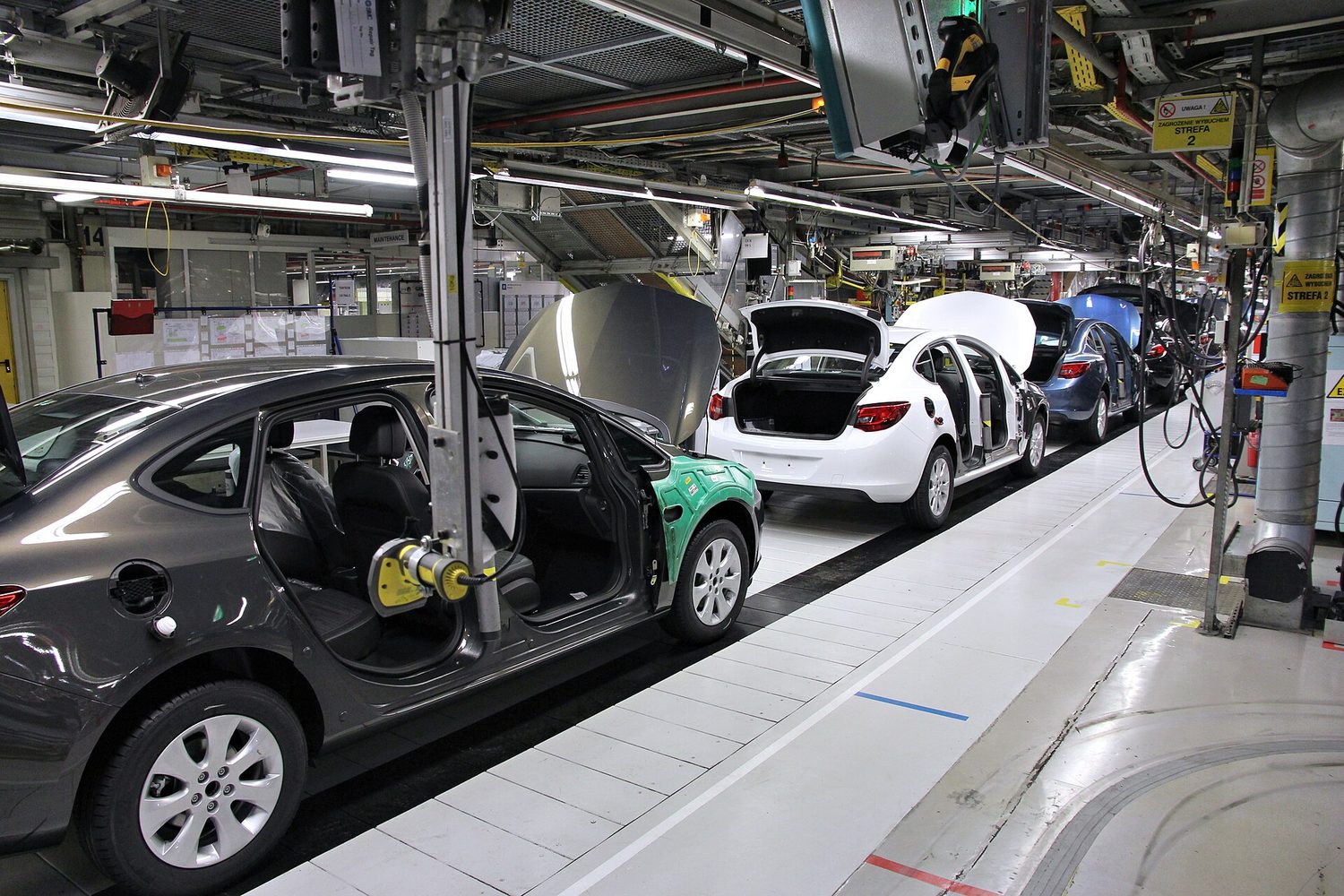
- capital-intensive 资本密集型 production uses a lot of capital (machines) and few workers — for example, a modern car factory.
A car assembly line is capital-intensive (many machines, few workers) and uses the division of labour — each worker repeats one task Productivity
Productivity 生产率 means output per worker (or per machine) in a set time. Higher productivity means each worker makes more, so the cost of each unit falls. Training, better machines, and good management all raise productivity.
Demand for and supply of factors
Firms buy factors of production 生产要素 (land 土地, labour, capital, and enterprise 企业家才能). The price and amount of each factor are set by its own demand and supply, just like any market. For example, if many firms want skilled workers, the wage for those workers rises.
Economies and diseconomies of scale
As a firm grows and makes more, the cost of each unit can change:
- economies of scale 规模经济 — as output rises, the average cost of each unit falls. Reasons: buying materials in bulk is cheaper, big machines work more efficiently, and large firms borrow money cheaply.
- diseconomies of scale 规模不经济 — if a firm grows too big, the average cost of each unit starts to rise. Reasons: a huge firm is hard to manage, messages travel slowly, and workers may feel less important.

Average cost falls as a firm grows (economies of scale), reaches a low point, then rises if it grows too big (diseconomies of scale). These can be internal (caused by the firm's own size) or external (caused by the whole industry growing).
ExploreFactors of production lab
Sort real resources by the factor of production they represent.
Vocabulary TrainEnglish Chinese Pinyin labour-intensive 劳动密集型 láo dòng mì jí xíng labour 劳动 láo dòng capital-intensive 资本密集型 zī běn mì jí xíng productivity 生产率 shēng chǎn lǜ factors of production 生产要素 shēng chǎn yào sù land 土地 tǔ dì enterprise 企业家才能 qǐ yè jiā cái néng economies of scale 规模经济 guī mó jīng jì diseconomies of scale 规模不经济 guī mó bù jīng jì 3.6
Firms' costs, revenue and objectives

Syllabus
- define and calculate fixed, variable, total and average costs
- define and calculate total and average revenue
- explain the objectives of firms (profit, survival, growth, social objectives)
Source: Cambridge International syllabus
Costs
A cost 成本 is money a firm spends to produce. Costs split into:
- fixed costs 固定成本 — costs that do not change with output, such as rent and insurance. You pay them even if you make nothing.
- variable costs 可变成本 — costs that change with output, such as materials and power. More output means more variable cost.
- total cost 总成本 — fixed cost plus variable cost.
- average cost 平均成本 — the cost of each unit: total cost divided by the number of units made.
Fixed cost stays the same as output rises; variable cost rises; total cost is fixed plus variable, so the gap between total and variable cost is the fixed cost. Revenue
Revenue 收益 is the money a firm gets from selling its goods.
- total revenue 总收益 — the price multiplied by the quantity sold.
- average revenue 平均收益 — total revenue divided by the quantity sold (this is the same as the price).
Profit and other objectives
Profit 利润 is what is left after costs:
profit = total revenue − total cost
Worked example. A firm has fixed costs of £2,000 and variable costs of £3 per unit. It makes 500 units and sells them at £10 each. Find its total cost, total revenue, profit and average cost.
- variable cost = 3 × 500 = £1,500, so total cost = 2,000 + 1,500 = £3,500.
- total revenue = 10 × 500 = £5,000.
- profit = 5,000 - 3,500 = £1,500.
- average cost = total cost ÷ units = 3,500 ÷ 500 = £7 per unit.
The firm makes a profit because the price (£10) is above the average cost (£7).
Most firms want as much profit as possible. But firms can have other objectives 目标:
- survival 生存 — a new firm first just wants to stay open.
- growth 增长 — getting bigger, to gain economies of scale and market power.
- social objectives — some firms aim to help people or protect the environment, not only to earn profit.
ExploreA firm's cost curves
Change output and see how average cost falls then rises — and where marginal cost crosses it.
Vocabulary TrainEnglish Chinese Pinyin cost 成本 chéng běn fixed costs 固定成本 gù dìng chéng běn variable costs 可变成本 kě biàn chéng běn total cost 总成本 zǒng chéng běn average cost 平均成本 píng jūn chéng běn revenue 收益 shōu yì total revenue 总收益 zǒng shōu yì average revenue 平均收益 píng jūn shōu yì profit 利润 lì rùn objectives 目标 mù biāo survival 生存 shēng cún growth 增长 zēng zhǎng 3.7
Types of markets

Syllabus
- describe the characteristics of competitive markets and monopoly
- explain the advantages and disadvantages of competition for consumers and firms
Source: Cambridge International syllabus
Markets differ by how many firms there are and how hard it is for new firms to join.
Markets range from monopoly (one seller) to perfect competition (many) Competitive markets
A competitive market has many firms selling similar goods, and it is easy for new firms to enter. This is strong competition 竞争. In such a market:
- firms must keep prices low and quality high, or buyers go elsewhere.
- firms work hard to cut costs and make new products.
This is good for consumers: low prices, wide choice, and good quality.

In a competitive market many firms sell similar goods, so each must keep prices low and quality high to win customers Monopoly
A monopoly 垄断 is a market with only one firm, or one firm that controls most of it. New firms find it hard to enter because of barriers to entry 进入壁垒 — for example, very high start-up costs, or the one firm controlling key supplies.
In a monopoly:
- the firm can charge high prices, because buyers have no other choice.
- there is little pressure to improve quality or cut costs.
- but a large monopoly may gain economies of scale, and may use its profit to pay for research.
Competition versus monopoly
Consumers Firms competition lower prices, more choice, better quality lower profit; must work hard to survive monopoly higher prices, less choice higher profit and an easy life, but may grow lazy ExploreEconomics case lab
Classify real examples by the economic idea they show.
Vocabulary TrainEnglish Chinese Pinyin competition 竞争 jìng zhēng monopoly 垄断 lǒng duàn barriers to entry 进入壁垒 jìn rù bì lěi 3.7
Exam tips
- Money's four functions: a medium of exchange, a store of value, a unit of account, and a means of deferred payment.
- Key formulas: profit = total revenue − total cost; total revenue = price × quantity; average cost = total cost ÷ number of units.
- Fixed costs do not change with output (rent, insurance); variable costs do (materials, power). Total cost = fixed + variable.
- Economies of scale make average cost fall as a firm grows; growing too big brings diseconomies of scale (average cost rises).
- Know the merger types: horizontal (same stage of the same industry), vertical (different stages of one industry), conglomerate (different industries).
-
4 Government and the macroeconomy
4.1
Government macroeconomic aims

Syllabus
- state the macroeconomic aims of government (economic growth, full employment/low unemployment, price stability, balance of payments stability, redistribution of income)
- explain why aims may conflict
Source: Cambridge International syllabus
Governments try to manage the whole economy — the macroeconomy 宏观经济. They have five main aims:
Five main aims: growth, low unemployment, stable prices, balance of payments stability, fair incomes - economic growth 经济增长 — the economy makes more goods and services each year.
- full employment 充分就业 — almost everyone who wants a job has one, so unemployment 失业 is low.
- price stability 价格稳定 — prices rise only slowly, so inflation 通货膨胀 is low.
- balance of payments 国际收支 stability — the money flowing in and out of the country (from trade) is roughly even.
- redistribution of income 收入再分配 — sharing income more fairly, so the gap between rich and poor is not too wide.
These aims can conflict 冲突 (work against each other). For example, fast growth can pull prices up, causing inflation. Cutting unemployment can do the same. So a government must balance its aims.

The government's three sets of policy tools for managing the macroeconomy ExploreManaging aggregate demand
Government policy moves aggregate demand against aggregate supply to steer output and the price level.
Vocabulary TrainEnglish Chinese Pinyin macroeconomy 宏观经济 hóng guān jīng jì economic growth 经济增长 jīng jì zēng zhǎng full employment 充分就业 chōng fèn jiù yè unemployment 失业 shī yè price stability 价格稳定 jià gé wěn dìng inflation 通货膨胀 tōng huò péng zhàng balance of payments 国际收支 guó jì shōu zhī redistribution of income 收入再分配 shōu rù zài fēn pèi conflict 冲突 chōng tū 4.2
Fiscal policy

Syllabus
- define fiscal policy (government spending and taxation) and the government budget (surplus, deficit, balance)
- distinguish direct and indirect taxes and progressive, regressive and proportional taxes
- explain the effects of fiscal policy on government macroeconomic aims
Source: Cambridge International syllabus
Fiscal policy 财政政策 means the government changing two things to manage the economy:
- government spending 政府支出 — money the government spends, for example on schools, hospitals, and roads.
- taxation 税收 — money the government takes from people and firms.
The government budget 预算 sets spending against tax. There are three outcomes:
- a budget deficit 预算赤字 — spending is more than the tax raised, so the government must borrow.
- a budget surplus 预算盈余 — the tax raised is more than spending.
- a balanced budget — the two are equal.
Types of tax
Taxes are grouped in two ways. By what is taxed:
- a direct tax 直接税 is paid straight to the government from income 收入 or profit 利润 (income tax, corporation tax).
- an indirect tax 间接税 is added to the price of goods and paid when you spend (a sales tax).
By how the rate changes with income:
- a progressive tax 累进税 takes a bigger % from higher incomes. This helps redistribute income.
- a regressive tax 累退税 takes a smaller % from higher incomes, so it hits the poor harder.
- a proportional tax 比例税 takes the same % from everyone.
Under a progressive tax the average rate rises with income; under a regressive tax it falls; under a proportional tax it stays the same. What fiscal policy does
To boost the economy (raise growth and jobs), the government can spend more or cut taxes. This raises total demand 需求 — but if demand grows too fast, it can cause inflation.
To slow the economy (fight inflation), the government can spend less or raise taxes. This lowers demand, but can raise unemployment.
ExploreFiscal policy shifts AD
Spending more or taxing less shifts aggregate demand right — raising output, but also the price level.
Vocabulary TrainEnglish Chinese Pinyin Fiscal policy 财政政策 cái zhèng zhèng cè government spending 政府支出 zhèng fǔ zhī chū taxation 税收 shuì shōu budget 预算 yù suàn budget deficit 预算赤字 yù suàn chì zì budget surplus 预算盈余 yù suàn yíng yú direct tax 直接税 zhí jiē shuì income 收入 shōu rù profit 利润 lì rùn indirect tax 间接税 jiàn jiē shuì progressive tax 累进税 lèi jìn shuì regressive tax 累退税 lèi tuì shuì proportional tax 比例税 bǐ lì shuì demand 需求 xū qiú 4.3
Monetary policy

Syllabus
- define monetary policy (interest rates, money supply) and the role of the central bank
- explain the effects of changes in interest rates on the economy
Source: Cambridge International syllabus
Monetary policy 货币政策 is the central bank 中央银行 changing interest rates 利率 (and the money supply 货币供给) to manage the economy. The interest rate is the cost of borrowing and the reward for saving.
- Lower interest rates: borrowing is cheaper, so people and firms spend and invest 投资 more. Demand rises, giving more growth and jobs — but maybe more inflation.
- Higher interest rates: borrowing is dearer, so spending falls. Demand falls, giving less inflation — but maybe more unemployment.
The central bank runs monetary policy: it sets the interest rate to manage demand, inflation and growth ExploreMonetary policy shifts AD
Lower interest rates encourage borrowing and spending, shifting aggregate demand right.
Vocabulary TrainEnglish Chinese Pinyin Monetary policy 货币政策 huò bì zhèng cè central bank 中央银行 zhōng yāng yín háng interest rates 利率 lì lǜ money supply 货币供给 huò bì gōng jǐ invest 投资 tóu zī interest rate 利率 lì lǜ 4.4
Supply-side policy
Syllabus
- define supply-side policy (education and training, privatisation, deregulation, incentives)
- explain the effects of supply-side policy on government macroeconomic aims
Source: Cambridge International syllabus
Supply-side policy 供给侧政策 tries to raise the amount the economy can produce. It improves the quantity and quality of the factors of production 生产要素. Methods include:
- education and training — better skills raise productivity 生产率.
- privatisation 私有化 — selling state-owned firms to private owners, who may run them better.
- deregulation 放松管制 — removing rules that hold firms back.
- incentives 激励 — lower taxes on income and profit, so people work harder and firms invest more.
Supply-side policy can raise growth and jobs and lower inflation at the same time. Its weakness is that it works slowly.
ExploreEconomics case lab
Classify real examples by the economic idea they show.
Vocabulary TrainEnglish Chinese Pinyin Supply-side policy 供给侧政策 gōng jǐ cè zhèng cè factors of production 生产要素 shēng chǎn yào sù productivity 生产率 shēng chǎn lǜ privatisation 私有化 sī yǒu huà deregulation 放松管制 fàng sōng guǎn zhì incentives 激励 jī lì 4.5
Economic growth

Syllabus
- define economic growth as an increase in real GDP; define GDP and real GDP
- describe the business cycle (boom, recession, slump, recovery)
- explain the causes, consequences (costs and benefits) of economic growth and recession
Source: Cambridge International syllabus
Economic growth is a rise in real GDP.
GDP (gross domestic product 国内生产总值) is the total value of all goods and services a country produces in a year. Real 实际 GDP is GDP after the effect of rising prices is removed, so it shows the true change in output.
Worked example. A country's real GDP was £500 billion last year and £515 billion this year. Find the rate of economic growth.
- economic growth = (515 - 500) ÷ 500 × 100 = 3%.
Because this uses real GDP (with the effect of rising prices taken out), the 3% is a true rise in output, not just higher prices. If prices had risen but output had not, real GDP — and so growth — would be zero.
Investment in new buildings and capital, seen in Shanghai's Pudong skyline, drives economic growth The business cycle
Real GDP does not rise smoothly. It moves through a business cycle 经济周期 with four stages:
- boom 繁荣 — fast growth; output and jobs are high, but prices rise quickly.
- recession 衰退 — output falls and jobs are lost. (A recession is often defined as falling real GDP for six months.)
- slump 萧条 — the bottom of the cycle; very low output and high unemployment.
- recovery 复苏 — output starts to rise again.

Real GDP moves through boom, recession, slump and recovery around its rising trend. Causes and effects
Growth comes from more or better factors of production: investment in new machines, a bigger or more skilled workforce, and new technology.
Good effects: higher incomes, more jobs, better living standards 生活水平, and more tax for the government to spend.
Bad effects: prices may rise (inflation); the gap between rich and poor may grow; and there may be more pollution and use of scarce resources.
A recession brings the opposite: lower incomes, more unemployment, and business failures.
ExploreEconomic growth
Growth shifts the whole frontier outward — the economy can now produce more of both goods.
Vocabulary TrainEnglish Chinese Pinyin gross domestic product 国内生产总值 guó nèi shēng chǎn zǒng zhí Real 实际 shí jì business cycle 经济周期 jīng jì zhōu qī boom 繁荣 fán róng recession 衰退 shuāi tuì slump 萧条 xiāo tiáo recovery 复苏 fù sū living standards 生活水平 shēng huó shuǐ píng 4.6
Employment and unemployment

Syllabus
- define and measure unemployment (claimant count, labour force survey)
- explain the types of unemployment (frictional, structural, cyclical/demand-deficient) and their causes
- explain the consequences of unemployment and the patterns/changes in employment
Source: Cambridge International syllabus
Measuring unemployment
Unemployment is people who can work and want to work, but cannot find a job. There are two ways to measure it:
- the claimant count 失业救济申领人数 — it counts people who claim unemployment benefit 失业救济金. It misses those who want work but cannot claim.
- the labour force survey 劳动力调查 — a survey that counts people who are not working but are looking for work and are ready to start.
The labour force 劳动力 is everyone who is working plus everyone who is unemployed (and looking for work).
Worked example. A country has 24 million people in work and 2 million people who are unemployed and looking for work. Find the labour force and the unemployment rate.
- labour force = 24 + 2 = 26 million.
- unemployment rate = 2 ÷ 26 × 100 = 7.7%.
People who are not looking for work (for example retired people or full-time students) are counted in neither figure, so a fall in the rate is good news only if it means more people found jobs, not that they stopped looking.
Types of unemployment
- frictional unemployment 摩擦性失业 — short-term unemployment between jobs (a worker who just left one job and is looking for the next).
- structural unemployment 结构性失业 — a whole industry shrinks and workers' skills are no longer wanted (for example, coal miners after the mines close).
- cyclical unemployment 周期性失业 — caused by a recession, when total demand is low so firms need fewer workers. (It is also called demand-deficient unemployment.)
Unemployment means people who want a job cannot find one 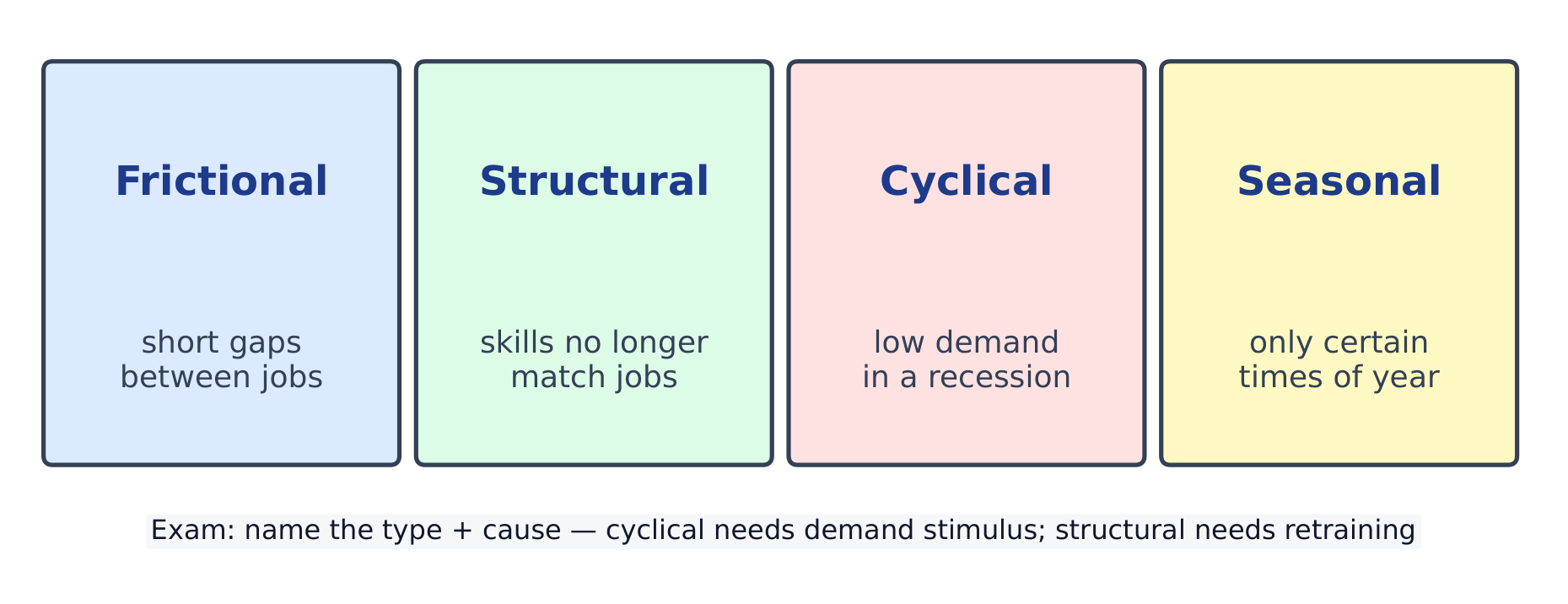
The four types of unemployment: frictional (between jobs), structural (skills no longer match), cyclical (low demand in a recession) and seasonal Effects of unemployment
- workers lose income and may lose their skills.
- the country loses the output those workers could have made.
- the government pays more in benefits and collects less in tax.
- crime and poor health may rise.
Sectors and the changing pattern of employment
The economy has three sectors:
- the primary sector 第一产业 extracts raw materials (farming, fishing, mining);
- the secondary sector 第二产业 makes things (manufacturing, construction);
- the tertiary sector 第三产业 provides services (banking, tourism, retail, transport).
As a country develops, jobs shift primary → secondary → tertiary. Early on most work is farming; industrialisation moves workers into factories; then deindustrialisation 去工业化 and rising incomes grow the service sector, so most jobs end up tertiary. Modern economies also see more part-time and flexible work.

A long queue of people — unemployment is people willing and able to work who cannot find jobs ExploreDevelopment chain lab
Follow how policy and resources can change living standards.
Vocabulary TrainEnglish Chinese Pinyin claimant count 失业救济申领人数 shī yè jiù jì shēn lǐng rén shù unemployment benefit 失业救济金 shī yè jiù jì jīn labour force survey 劳动力调查 láo dòng lì diào chá labour force 劳动力 láo dòng lì frictional unemployment 摩擦性失业 mó cā xìng shī yè structural unemployment 结构性失业 jié gòu xìng shī yè cyclical unemployment 周期性失业 zhōu qī xìng shī yè primary sector 第一产业 dì yī chǎn yè secondary sector 第二产业 dì èr chǎn yè tertiary sector 第三产业 dì sān chǎn yè deindustrialisation 去工业化 qù gōng yè huà 4.7
Inflation

Syllabus
- define inflation and deflation and explain how they are measured (Consumer Prices Index)
- explain the causes (demand-pull and cost-push) and the consequences of inflation and deflation
Source: Cambridge International syllabus
Inflation is a rise in the average level of prices over time. The opposite — falling prices — is deflation 通货紧缩.
Measuring inflation
Inflation is measured by the Consumer Prices Index 消费者价格指数 (CPI). We pick a "basket" of goods a typical family buys, give each good a weight 权重 (a bigger weight for things people spend more on), and track how the price of the whole basket changes each year.
Worked example. A country's Consumer Prices Index (CPI) was 100 last year and 104 this year. Find the rate of inflation.
- inflation rate = (104 - 100) ÷ 100 × 100 = 4%.
Prices rose by 4% on average. If next year the index reaches 107, the inflation rate is (107 - 104) ÷ 104 × 100 = 2.9%. Prices are still rising, but more slowly — a smaller inflation rate is not the same as deflation, because for deflation the index itself would have to fall.
Causes
- demand-pull 需求拉动 inflation — total demand grows faster than the economy can supply, so prices are pulled up.
- cost-push 成本推动 inflation — firms' costs rise (wages, materials), so they raise prices to cover them.
The two causes of inflation: demand-pull (excess demand) and cost-push (rising costs) Effects of inflation
- money loses purchasing power 购买力 — each unit of money buys less.
- savings become worth less.
- firms must keep changing prices on labels and lists, which costs time and money.
- the country's goods become dearer than other countries' goods, which hurts exports.
Deflation
Falling prices sound good, but deflation can be harmful. People put off buying, hoping for lower prices later. So demand falls, firms cut output, and unemployment rises.
ExploreDemand-pull inflation
When aggregate demand rises faster than supply, the price level is pulled up — that is inflation. Push demand and watch prices climb.
Vocabulary TrainEnglish Chinese Pinyin deflation 通货紧缩 tōng huò jǐn suō Consumer Prices Index 消费者价格指数 xiāo fèi zhě jià gé zhǐ shù weight 权重 quán zhòng demand-pull 需求拉动 xū qiú lā dòng cost-push 成本推动 chéng běn tuī dòng purchasing power 购买力 gòu mǎi lì 4.7
Exam tips
- Learn the government's five aims (growth, low unemployment, low inflation, balance of payments, fair incomes) — they can conflict, e.g. fast growth can pull up inflation.
- Fiscal policy = government spending and taxes; monetary policy = the central bank changing interest rates; supply-side policy = raising what the economy can produce.
- Key rates: unemployment rate = unemployed ÷ labour force × 100; inflation rate = change in CPI ÷ old CPI × 100; growth = change in real GDP ÷ old real GDP × 100.
- Deflation (falling prices) can be harmful, because people delay buying, so demand and jobs fall.
-
5 Economic development
5.1
Living standards

Syllabus
- explain the indicators of living standards (real GDP per head, Human Development Index — HDI)
- compare living standards and income distribution within and between countries and the limitations of comparisons
Source: Cambridge International syllabus
"Living standards" means how well people live — their income, health, education, and quality of life.
Indicators of living standards
An indicator 指标 is a number we use to measure something. Two indicators of living standards 生活水平 are common.
Real GDP per head is the main one. GDP (gross domestic product 国内生产总值) is the total value of goods and services a country makes in a year. Real 实际 means after rising prices are taken out. Per head 人均 means divided by the number of people. So real GDP per head shows the average output — and roughly the average income 收入 — of each person. Higher real GDP per head usually means higher living standards.
Worked example. A country produces real GDP of £600 billion and has a population of 50 million people. Find its real GDP per head.
- real GDP per head = 600 billion ÷ 50 million = £12,000 per person.
This is only an average. It does not show how the income is shared: the same £12,000 average could hide most people being much poorer while a few are very rich. That is why HDI, below, adds health and education.
The Human Development Index 人类发展指数 (HDI) is a wider measure. It combines three things: income per head, education (years of schooling), and health (measured by life expectancy 预期寿命 — how long people are expected to live). HDI gives a fuller picture than GDP alone.
The HDI combines income (GNI per head), education (years of schooling) and health (life expectancy) into one number between 0 and 1 Limits of the comparison
Comparing living standards is not simple:
- GDP per head is an average. It hides the income distribution 收入分配 — a country can have a high average but a few rich people and many poor people.
- it leaves out unpaid work, and work in the hidden economy.
- it does not measure pollution, free time, or safety.
- prices and money differ between countries, so the same income buys different amounts.
This is why HDI, which adds health and education, is often a better guide.
ExploreEconomics case lab
Classify real examples by the economic idea they show.
Vocabulary TrainEnglish Chinese Pinyin indicator 指标 zhǐ biāo living standards 生活水平 shēng huó shuǐ píng gross domestic product 国内生产总值 guó nèi shēng chǎn zǒng zhí real 实际 shí jì per head 人均 rén jūn income 收入 shōu rù Human Development Index 人类发展指数 rén lèi fā zhǎn zhǐ shù life expectancy 预期寿命 yù qī shòu mìng income distribution 收入分配 shōu rù fēn pèi 5.2
Poverty

Syllabus
- distinguish absolute and relative poverty and explain the causes of poverty
- explain policies to alleviate poverty and redistribute income
Source: Cambridge International syllabus
Poverty 贫困 is when people cannot afford a basic standard of living. There are two types:
- absolute poverty 绝对贫困 — people cannot afford even the basics: enough food, clean water, shelter, and clothing.
- relative poverty 相对贫困 — people are poor compared with others in the same country. They can afford the basics but much less than most people around them.
Two types of poverty: absolute (cannot afford basic needs) and relative (poor compared with others in the same country) 
Absolute poverty: in informal settlements many people lack basic needs such as safe housing, clean water and sanitation Causes of poverty
- low income, low wages 工资, or no job (unemployment).
- poor education and poor health, which make it hard to get good work.
- old age, or having many children to support.
Policies to reduce poverty
- economic growth 经济增长 — a growing economy creates jobs and income.
- redistribute 再分配 income — use progressive taxes on the rich to pay for help for the poor.
- a minimum wage 最低工资 — a legal lowest wage, so low-paid workers earn more.
- state benefits 福利 — money paid by the government to the poor, old, or unemployed.
- better state education and healthcare, so the poor can improve their lives.
ExploreEconomics case lab
Classify real examples by the economic idea they show.
Vocabulary TrainEnglish Chinese Pinyin poverty 贫困 pín kùn absolute poverty 绝对贫困 jué duì pín kùn relative poverty 相对贫困 xiāng duì pín kùn wages 工资 gōng zī economic growth 经济增长 jīng jì zēng zhǎng redistribute 再分配 zài fēn pèi minimum wage 最低工资 zuì dī gōng zī benefits 福利 fú lì 5.3
Population

Syllabus
- explain the factors affecting population growth (birth rate, death rate, net migration) and the structure of a population (population pyramids)
- explain the effects of changes in the size and structure of population (e.g. ageing population) on an economy
Source: Cambridge International syllabus
A country's population 人口 is the number of people living in it. Three things change its size.
- the birth rate 出生率 — the number of births each year for every 1000 people.
- the death rate 死亡率 — the number of deaths each year for every 1000 people.
- migration 移民 — people moving between countries. immigration 迁入 is people moving in; emigration 迁出 is people moving out. Net migration 净移民 is immigration minus emigration.
The population grows when births plus immigration are more than deaths plus emigration.
Worked example. In one year a country has 800,000 births, 500,000 deaths, 300,000 immigrants and 100,000 emigrants. Find the net migration and the total change in population.
- net migration = immigration - emigration = 300,000 - 100,000 = 200,000 (a net gain).
- natural change = births - deaths = 800,000 - 500,000 = 300,000.
- total change = natural change + net migration = 300,000 + 200,000 = 500,000.
So the population grew by 500,000 people that year.
A country's population grows when births plus immigration are greater than deaths plus emigration Population structure
The population structure 人口结构 is how the population is split by age and sex. We often draw it as a population pyramid 人口金字塔 — a chart with age groups stacked up, males on one side and females on the other.

A developing country has a wide-based, youthful pyramid; a developed country is more column-shaped with a wider top (an ageing population). An ageing population
In many richer countries the ageing population 人口老龄化 is a big change: people live longer and have fewer children, so the share of old people rises. Effects:
- fewer workers compared with the number of retired people, so each worker must support more people.
- the government spends more on pensions and healthcare.
- it may need higher taxes, or workers from other countries, to fill the gap.

The main effects of an ageing population ExploreDevelopment chain lab
Follow how policy and resources can change living standards.
Vocabulary TrainEnglish Chinese Pinyin population 人口 rén kǒu birth rate 出生率 chū shēng lǜ death rate 死亡率 sǐ wáng lǜ migration 移民 yí mín immigration 迁入 qiān rù emigration 迁出 qiān chū net migration 净移民 jìng yí mín population structure 人口结构 rén kǒu jié gòu population pyramid 人口金字塔 rén kǒu jīn zì tǎ ageing population 人口老龄化 rén kǒu lǎo líng huà 5.4
Differences in economic development between countries

Syllabus
- explain the differences in economic development between countries (income, productivity, population, resources, education, health, debt, trade)
- explain how these differences affect living standards and the relationship between developed and developing economies
Source: Cambridge International syllabus
Economic development 经济发展 means a rise in people's well-being, not just more output. We often split the world into developed countries 发达国家 (rich, like Japan or Germany) and developing countries 发展中国家 (poorer, with lower incomes).
A developed economy: high incomes support a modern city of offices, finance and services Why countries differ
- income — developed countries have much higher income per head.
- productivity 生产率 — developed countries use more capital and skill, so each worker produces more. In many developing countries, farmers do subsistence farming 自给农业 (growing food just for their own family), which produces little to sell.
- population — developing countries often have higher birth rates and younger populations.
- resources, education, and health — better schools, hospitals, and use of resources all raise development.
- debt 债务 — many developing countries owe large amounts of money, and paying it back leaves less for schools and hospitals.
- trade 贸易 — developed countries trade more, and often sell higher-value goods.
How developed and developing countries are linked
The two groups depend on each other. Developing countries sell raw materials and cheap goods to developed countries, and buy machines and skills from them. Trade, aid, and investment from richer countries can help poorer countries develop — but developing countries can also become too dependent on them.
ExploreDevelopment chain lab
Follow how policy and resources can change living standards.
Vocabulary TrainEnglish Chinese Pinyin economic development 经济发展 jīng jì fā zhǎn developed countries 发达国家 fā dá guó jiā developing countries 发展中国家 fā zhǎn zhōng guó jiā productivity 生产率 shēng chǎn lǜ subsistence farming 自给农业 zì jǐ nóng yè debt 债务 zhài wù trade 贸易 mào yì 5.4
Exam tips
- Real GDP per head = GDP ÷ population, but it is an average that hides how income is shared. HDI adds health and education for a fuller picture.
- A population grows when births + immigration is greater than deaths + emigration. Net migration = immigration − emigration.
- An ageing population means fewer workers for each retired person, so more government spending on pensions and healthcare.
- Distinguish absolute poverty (cannot afford basic needs like food and shelter) from relative poverty (poor compared with others in the same country).
-
6 International trade and globalisation
6.1
Specialisation and free trade

Syllabus
- explain specialisation at national level and the benefits and disadvantages of free international trade
- explain the role of free trade in raising living standards
Source: Cambridge International syllabus
Countries trade 贸易 with each other: they sell some goods and buy others. Just as one worker can focus on one task, a whole country can focus on making the goods it is best at. This is specialisation 专业化 at a national level.
Each country makes what it is best at, then trades 
Exports are sold abroad; imports are bought from abroad 
A container port: countries specialise and trade huge volumes of goods by sea When a country specialises, it sells the goods it makes well (exports 出口) and buys the goods other countries make well (imports 进口).
Free trade
Free trade 自由贸易 means trade between countries with no barriers — no taxes or limits on imports. Its benefits:
- countries can buy some goods more cheaply from abroad than by making them at home.
- consumers get a wider choice of goods.
- firms can sell to bigger markets, so they gain economies of scale.
- more competition makes domestic 国内的 firms (firms in your own country) work harder and improve.
All of this can raise living standards 生活水平: lower prices and more goods for everyone.
Free trade also has disadvantages:
- domestic firms may not be able to compete 竞争 with cheaper foreign goods, so they close. This causes job losses.
- a country can become too dependent 依赖 on other countries for important goods.
- new, small industries may never grow if they face strong foreign rivals from the start.
ExploreSpecialisation and trade
By specialising where its opportunity cost is lowest and trading, a country can consume beyond its own frontier.
Vocabulary TrainEnglish Chinese Pinyin trade 贸易 mào yì specialisation 专业化 zhuān yè huà exports 出口 chū kǒu imports 进口 jìn kǒu free trade 自由贸易 zì yóu mào yì domestic 国内的 guó nèi de living standards 生活水平 shēng huó shuǐ píng compete 竞争 jìng zhēng dependent 依赖 yī lài 6.2
Globalisation and trade protection

Syllabus
- define globalisation and explain the role and impact of multinational companies (benefits and drawbacks to host countries)
- describe methods of trade protection (tariffs, quotas, subsidies, embargoes) and the reasons for and consequences of protection
Source: Cambridge International syllabus
Globalisation 全球化 is the way the world's economies are becoming more and more joined together — through trade, travel, the internet, and firms working across borders.
Multinational companies
A multinational company 跨国公司 (MNC) is a firm that produces in more than one country — for example, a car maker with factories in several countries. The country an MNC sets up in is the host country 东道国.
- Benefits to the host country: new jobs, investment, new skills and technology, and more tax.
- Drawbacks: profits may flow back to the MNC's home country; local firms may be pushed out; and some MNCs pay low wages or pollute (for example, by sending waste to poorer countries).
Trade protection
Trade protection 贸易保护 is a government putting up barriers to limit imports and protect its own firms. The main methods:
- a tariff 关税 — a tax on imports, which makes them dearer.
- a quota 配额 — a limit on the amount of a good that can be imported.
- a subsidy 补贴 — money paid to domestic firms so they can sell more cheaply than foreign rivals.
- an embargo 禁运 — a total ban on trade in a good, or with a country.
The four main methods of trade protection Reasons for protection: to protect jobs; to protect an infant industry 幼稚产业 (a new industry too small to compete yet); to stop dumping 倾销 (foreign firms selling below cost to destroy local rivals); and to raise government revenue from tariffs.
But protection has costs. Prices rise and choice falls for consumers; protected firms stay weak and lazy; and other countries may hit back with their own barriers — a trade war.

A tariff raises the price from the world price to "world price + tariff": domestic supply rises, demand falls, imports shrink, and the shaded box is the government's tariff revenue ExploreTrade restrictions in the market
A tariff raises the price of imports, shifting effective supply and protecting home producers at consumers' expense.
Vocabulary TrainEnglish Chinese Pinyin globalisation 全球化 quán qiú huà multinational company 跨国公司 kuà guó gōng sī host country 东道国 dōng dào guó trade protection 贸易保护 mào yì bǎo hù tariff 关税 guān shuì quota 配额 pèi é subsidy 补贴 bǔ tiē embargo 禁运 jìn yùn infant industry 幼稚产业 yòu zhì chǎn yè dumping 倾销 qīng xiāo 6.3
Foreign exchange rates

Syllabus
- define the exchange rate and explain how it is determined by demand and supply of currency (floating system)
- explain the causes and consequences of changes in the exchange rate (appreciation and depreciation) for the economy
Source: Cambridge International syllabus
Exchange rates: appreciation The exchange rate 汇率 is the price of one currency 货币 in terms of another — for example, £1 = 1.30 US dollars.
How the rate is set
In a floating exchange rate 浮动汇率 system, the rate is set by the demand 需求 for and supply 供给 of the currency, just like any market.
- if more people want a currency — to buy that country's exports, or to invest there — demand for it rises, so its price (the exchange rate) rises.
- for example, if a country's interest rates rise, foreigners want to save money there, so demand for its currency rises and the rate goes up.
The exchange rate is set where demand for the currency meets supply. If demand falls ($D \to D_1$), the rate falls — a depreciation. Appreciation and depreciation
- appreciation 升值 — the currency rises in value (it buys more foreign money).
- depreciation 贬值 — the currency falls in value.
A change in the rate changes the price of exports and imports:
- if a currency appreciates (rises), its exports become dearer for foreigners and its imports become cheaper. So exports fall and imports rise.
- if a currency depreciates (falls), its exports become cheaper for foreigners and its imports become dearer. So exports rise and imports fall.

How a change in the exchange rate affects exports and imports Worked example. The exchange rate is £1 = 1.30 US dollars. (a) A UK firm sells a machine for £2,000 — what is its price to a US buyer? (b) A US laptop costs 650 dollars — what does it cost a UK buyer?
- (a) price in dollars = 2,000 × 1.30 = 2,600 dollars.
- (b) price in pounds = 650 ÷ 1.30 = £500.
To change pounds into dollars you multiply by the rate; to change dollars into pounds you divide. Now suppose the pound appreciates to £1 = 1.50 dollars. The same £2,000 machine then costs a US buyer 2,000 × 1.50 = 3,000 dollars — dearer than before, which is why a stronger pound makes a country's exports harder to sell abroad.
ExploreThe foreign-exchange market
A currency is bought and sold like any good. More demand for it raises its exchange rate — it appreciates.
Vocabulary TrainEnglish Chinese Pinyin exchange rate 汇率 huì lǜ currency 货币 huò bì floating exchange rate 浮动汇率 fú dòng huì lǜ demand 需求 xū qiú supply 供给 gōng jǐ appreciation 升值 shēng zhí depreciation 贬值 biǎn zhí 6.4
The current account of the balance of payments
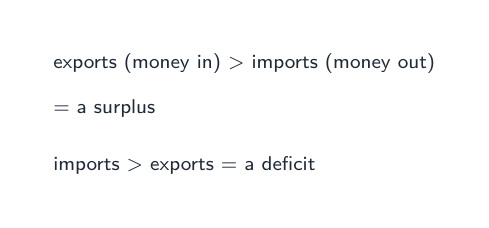
Syllabus
- describe the structure of the current account (trade in goods, trade in services, primary income, secondary income)
- explain the causes and consequences of, and policies to correct, a current account deficit or surplus
Source: Cambridge International syllabus
The balance of payments 国际收支 is a record of all the money flowing into and out of a country. Its main part is the current account 经常账户, which has four sections:
Exports above imports is a surplus; below is a deficit - trade in goods 货物贸易 — exports and imports of physical goods (cars, food, oil).
- trade in services 服务贸易 — exports and imports of services (tourism, banking, shipping).
- primary income 初次收入 — wages, interest, and profit earned from abroad.
- secondary income 二次收入 — money sent with nothing given in return, such as aid and gifts.

Cargo ships carry goods between countries — the trade-in-goods part of the current account Deficit and surplus
- a current account deficit 逆差 — more money flows out than in (the country buys more from abroad than it sells).
- a current account surplus 顺差 — more money flows in than out.
Correcting a deficit
A country with a large deficit must borrow money or sell assets to pay for it. To correct a deficit, a government can:
- cut total demand, so people buy fewer imports.
- let the currency depreciate, to make exports cheaper and imports dearer.
- use trade protection (tariffs and quotas) to cut imports.
- use supply-side policy to improve the competitiveness 竞争力 of its firms, so exports rise.
ExploreCurrent account flow
Track exports, imports and income flows into the current account.
Vocabulary TrainEnglish Chinese Pinyin balance of payments 国际收支 guó jì shōu zhī current account 经常账户 jīng cháng zhàng hù trade in goods 货物贸易 huò wù mào yì trade in services 服务贸易 fú wù mào yì primary income 初次收入 chū cì shōu rù secondary income 二次收入 èr cì shōu rù current account deficit 逆差 nì chà current account surplus 顺差 shùn chā competitiveness 竞争力 jìng zhēng lì 6.4
Exam tips
- To convert currency: pounds → dollars, multiply by the rate; dollars → pounds, divide by the rate.
- When a currency appreciates, its exports become dearer and its imports cheaper (so exports fall, imports rise); a depreciation does the opposite.
- Trade protection (tariffs, quotas, subsidies, embargoes) can protect jobs and infant industries, but it raises prices, cuts choice, and can start a trade war.
- A current account deficit means more money flows out than in. It can be reduced by cutting demand, letting the currency depreciate, or improving competitiveness.