Economies and diseconomies of scale
| English | Chinese | Pinyin |
|---|---|---|
| output | 产出 | chǎn chū |
| average cost | 平均成本 | píng jūn chéng běn |
| per unit | 每单位 | měi dān wèi |
| economies of scale | 规模经济 | guī mó jīng jì |
| optimal | 最优的 | zuì yōu de |
| diseconomies of scale | 规模不经济 | guī mó bù jīng jì |
| purchasing | 采购 | cǎi gòu |
| bulk-buying | 批量采购 | pī liàng cǎi gòu |
| coordination | 协调 | xié tiáo |
| motivation | 激励 | jī lì |
Why bigger can be cheaper
- A bakery making 10,000 loaves can buy flour far more cheaply per bag than one making 100.
- As output 产出 grows, the average cost 平均成本 per unit 每单位 often falls — the power of economies of scale 规模经济.
Economies of scale occur when, as output rises:
Average (per-unit) cost falls with greater scale.
The shape of average cost
- Economies of scale: as output rises, average cost falls.
- Beyond an optimal 最优的 size, diseconomies of scale 规模不经济 set in and average cost rises again.
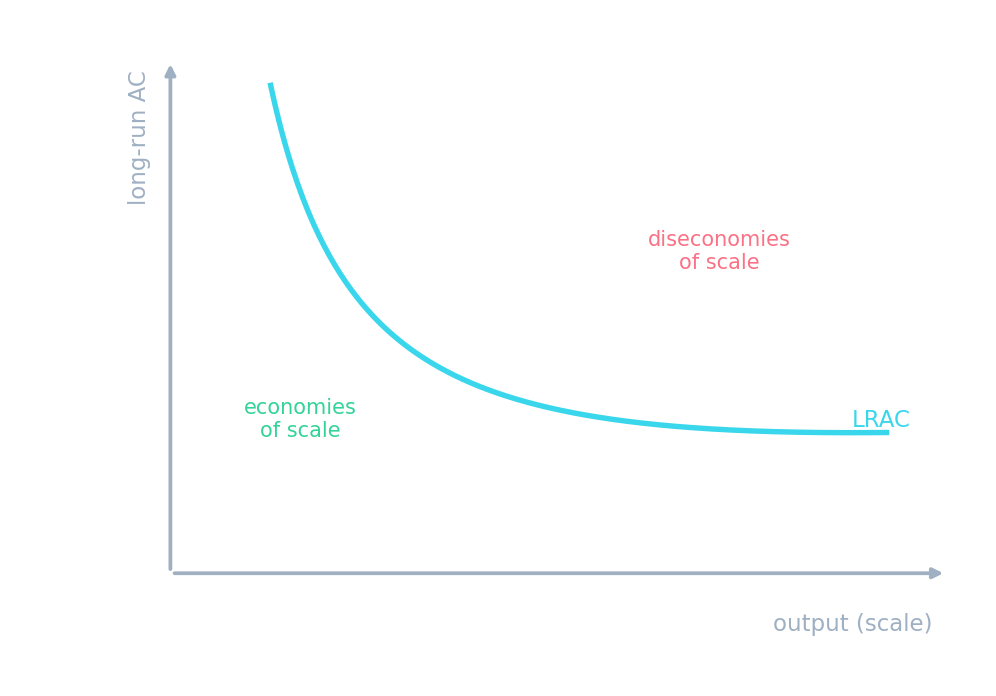
Average cost falls as the firm grows, reaches a minimum, then rises if it grows too large.
Economies of scale
y = ax² + bx + c
Average cost falls then rises — economies, then diseconomies, of scale.
Which are sources of economies of scale? (Select all that apply.)
Poor communication is a diseconomy, not an economy.
Sources of economies of scale
- Purchasing 采购: bulk-buying 批量采购 discounts.
- Technical: large, efficient machines spread over more output.
- Financial: big firms borrow more cheaply.
- Managerial: afford specialist managers.

Average cost per unit falls then rises as a firm grows
Diseconomies of scale cause average cost to:
Beyond the optimal size, average cost rises again.
When a firm grows so large that average cost rises, it suffers ______ of scale.
Communication and coordination problems drive diseconomies.
Diseconomies of scale
- Communication breaks down in large organisations.
- Coordination 协调 gets harder and slower.
- Motivation 激励 falls as workers feel like a small cog.
Economies of scale are about average cost, not total cost. Total cost still rises with output — it's the cost per unit that falls. Don't confuse the two.
Economies of scale lower the average cost per unit, even though total cost still rises with output.
It is per-unit cost that falls, not total cost.
You've got it
- economies of scale: average cost falls as output rises (purchasing, technical, financial, managerial)
- diseconomies of scale: average cost rises if too large (communication, coordination, motivation)
- it is average (per-unit) cost that falls, not total cost