Carbon-13 NMR
| English | Chinese | Pinyin |
|---|---|---|
| NMR | 核磁共振 | hé cí gòng zhèn |
| carbon environment | 碳环境 | tàn huán jìng |
| chemical shift | 化学位移 | huà xué wèi yí |
| superconducting | 超导 | chāo dǎo |
Mapping the carbons
- NMR 核磁共振 studies how certain nuclei behave in a strong magnetic field.
- In carbon-13 NMR, each different carbon environment 碳环境 gives one peak.
- This tells you about a molecule's carbon skeleton.
Carbon-13 NMR lab
Match carbon environments to C-13 NMR evidence.
The number of peaks in a carbon-13 NMR spectrum shows the number of different carbon ______.
Equivalent carbons give one peak.
Carbon-13 NMR gives information about the carbon skeleton of a molecule.
Each chemically different carbon gives a peak.
Reading a carbon-13 spectrum
- the number of peaks = the number of different carbon environments (equivalent carbons share a peak).
- the position of each peak (its chemical shift 化学位移) suggests the type of carbon.
- Together these help you deduce possible structures.
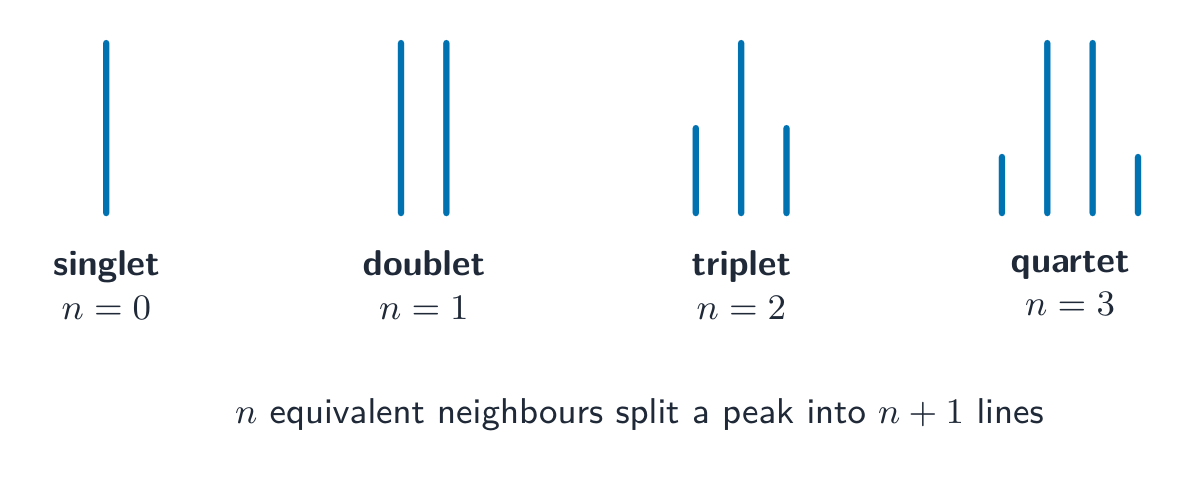
The n+1 rule: singlet, doublet, triplet, quartet
In carbon-13 NMR, the number of peaks tells you:
Each distinct carbon environment gives one peak; equivalent carbons share a peak.
The chemical shift (position) of a carbon-13 peak suggests:
The shift indicates the kind of carbon, helping to deduce the structure.
Equivalent carbons (in the same environment) give a single shared peak.
Carbons in identical environments are not distinguished, so they appear as one peak.
Counting environments
- The number of peaks equals the number of chemically different carbons.
- Equivalent carbons (by symmetry) give a single peak.

An NMR spectrometer: the large cylinder is a superconducting 超导 magnet that makes the very strong magnetic field the technique needs
Chemical shift gives a clue
- The position (chemical shift) of each peak hints at the type of carbon environment.
- A shift table links ranges to environments (e.g. C=O is far downfield).
You've got it
- carbon-13 NMR: each different carbon environment gives one peak
- the number of peaks = the number of carbon environments
- the chemical shift suggests the type of carbon, helping deduce the structure