The circular flow of income
| English | Chinese | Pinyin |
|---|---|---|
| firms | 企业 | qǐ yè |
| circular flow of income | 收入循环流 | shōu rù xún huán liú |
| households | 家庭 | jiā tíng |
| injections | 注入 | zhù rù |
| withdrawals | 漏出 | lòu chū |
| savings | 储蓄 | chǔ xù |
| investment | 投资 | tóu zī |
The economy as a loop
- Your wages come from a firm; you spend them at firms 企业; those firms pay wages again. Money goes round and round.
- The circular flow of income 收入循环流 captures this loop — and shows what makes an economy grow or shrink.
Households 家庭 and firms
- Households supply factors of production and receive income; they spend it on goods.
- Firms produce goods and pay households' incomes. Spending and income chase each other around the loop.
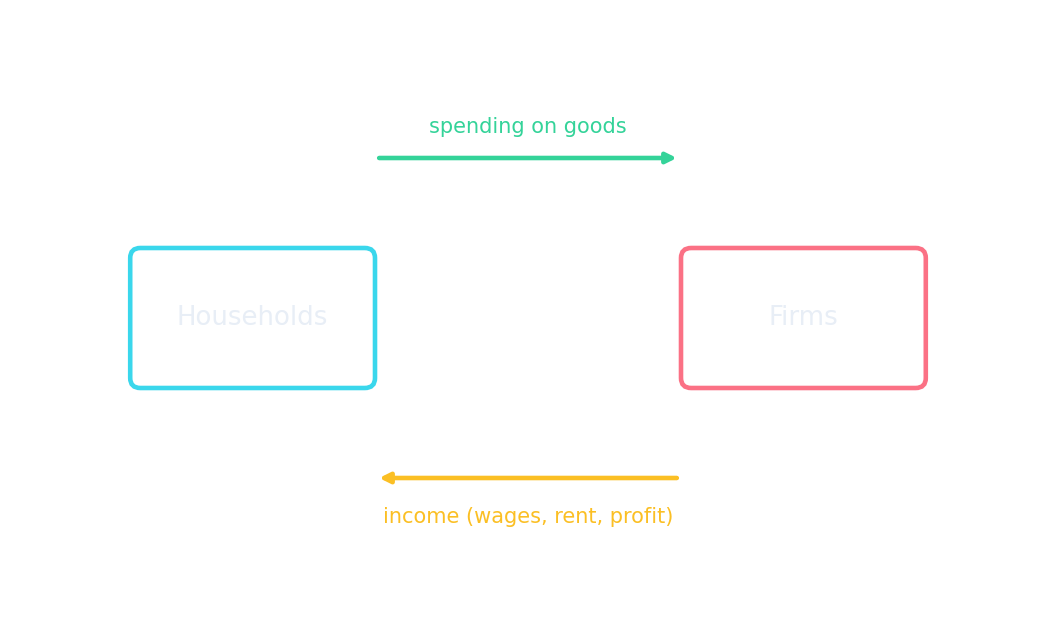
Spending flows from households to firms; income flows back — the basic two-sector circular flow.
Injections & leakages
Money loops between households and firms. Injections grow national income, leakages shrink it; they are equal at equilibrium.
The circular flow of income
Money flows in a loop: households earn income from firms, then spend it back on the firms' goods. Step round the cycle.
Injections 注入 and withdrawals 漏出
- Withdrawals (leakages) take money out of the loop: savings 储蓄 (S), taxes (T), imports (M).
- Injections add money in: investment 投资 (I), government spending (G), exports (X).

The circular flow of income with leakages and injections
Which is an injection into the circular flow?
Injections are investment, government spending and exports; the others are withdrawals.
Classify each flow.
Withdrawals (S, T, M) leak out; injections (I, G, X) add in.
Savings, taxes and imports are the three ______ from the circular flow.
They leak money out of the flow.
Equilibrium
- National income is in equilibrium when injections = withdrawals (S + T + M = I + G + X).
- If injections exceed withdrawals, income grows; if withdrawals exceed injections, it shrinks.
Saving is a withdrawal, not a boost. It may feel virtuous, but money saved leaves the circular flow — it only returns if it's borrowed and invested (an injection).
National income is in equilibrium when injections equal withdrawals.
When I + G + X = S + T + M, income is stable.
If injections exceed withdrawals, national income will:
More money enters the loop than leaves, so income rises.
You've got it
- the circular flow: households' spending → firms → income → households
- withdrawals (S, T, M) leak out; injections (I, G, X) add in
- equilibrium when injections = withdrawals; injections > withdrawals → income grows