Coordinate geometry
| English | Chinese | Pinyin |
|---|---|---|
| gradient | 斜率 | xié lǜ |
| perpendicular | 垂直 | chuí zhí |
| midpoint | 中点 | zhōng diǎn |
| perpendicular bisector | 垂直平分线 | chuí zhí píng fēn xiàn |
| tangent | 切线 | qiè xiàn |
The mathematics of location
- GPS satellites pinpoint your location to within a few metres using coordinate geometry.
- Every map, every blueprint, every computer graphic relies on the same core ideas: lines, circles, and the distances between points.
Straight lines
- Gradient 斜率 of the line through $(x_1, y_1)$ and $(x_2, y_2)$: $m = \dfrac{y_2 - y_1}{x_2 - x_1}$.
- Line equations: $y = mx + c$ (slope-intercept form), or $y - y_1 = m(x - x_1)$ (point-slope form).
- Parallel lines have equal gradients; perpendicular 垂直 lines have gradients that multiply to $-1$.
Worked example. Line through $(2, 3)$ and $(6, 11)$: $m = \dfrac{11-3}{6-2} = \dfrac{8}{4} = 2$. Equation: $y - 3 = 2(x - 2) \Rightarrow y = 2x - 1$.
Perpendicular gradient trap. If a line has gradient $2$, the perpendicular gradient is $-\dfrac{1}{2}$, not $-2$. You must flip the fraction and change the sign.
The straight line
y = ax + b
The gradient a tilts the line; the intercept b slides it up and down.
What is the gradient of the line through (2, 3) and (6, 11)?
m = (11 − 3) / (6 − 2) = 8/4 = 2.
A line has gradient 2. What is the gradient of a line perpendicular to it?
Perpendicular gradients multiply to −1, so the gradient is −1/2 = −0.5.
Midpoints 中点 and parallel lines
- The midpoint of $(x_1, y_1)$ and $(x_2, y_2)$ is $\left(\dfrac{x_1+x_2}{2}, \dfrac{y_1+y_2}{2}\right)$.
- The perpendicular bisector 垂直平分线 passes through the midpoint with the perpendicular gradient.
The midpoint of (2, 3) and (8, 7) has x-coordinate:
Midpoint x = (2 + 8)/2 = 5.
Circles
- A circle, centre $(a, b)$, radius $r$: $(x - a)^2 + (y - b)^2 = r^2$.
- An expanded form (e.g. $x^2 + y^2 - 6x + 10y - 27 = 0$) → complete the square in $x$ and $y$ to find the centre and radius.
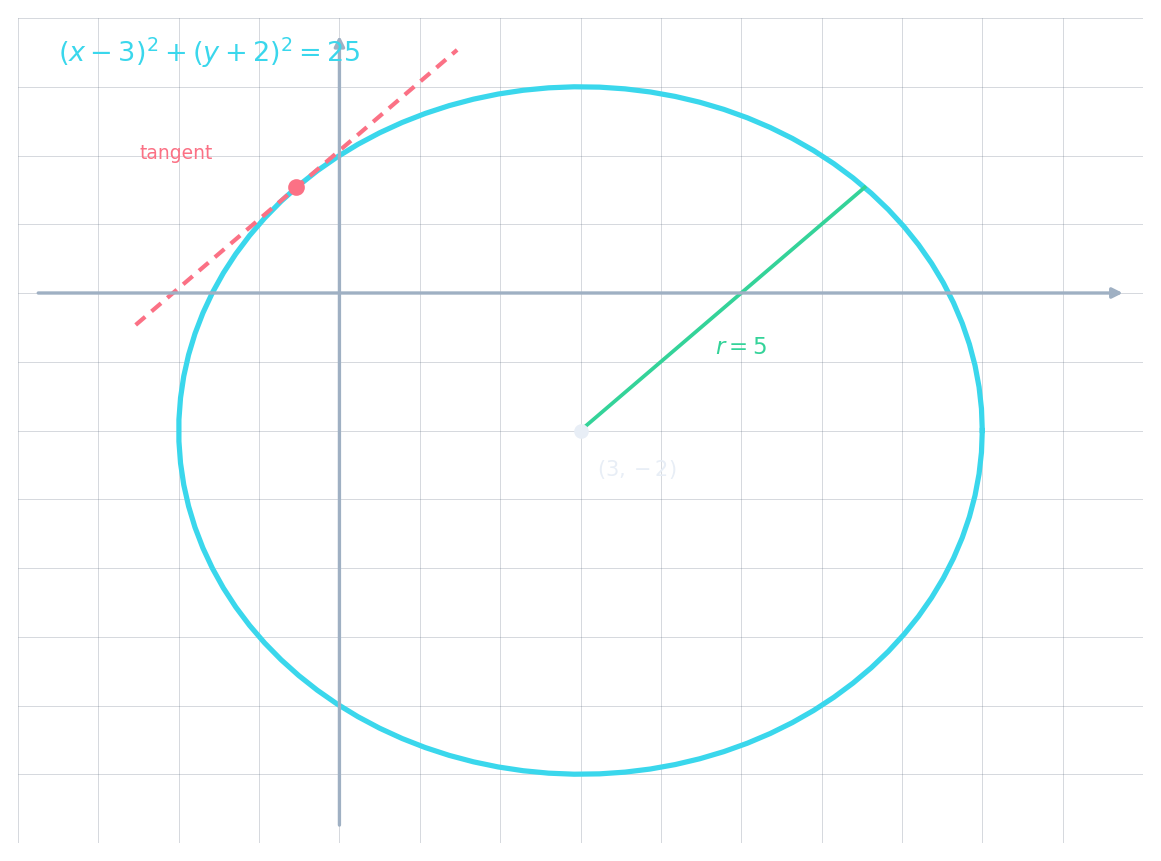
The equation $(x-3)^2 + (y+2)^2 = 25$ describes a circle with centre $(3, -2)$ and radius $5$.
The circle (x − 3)² + (y + 2)² = 25 has what radius?
r² = 25, so r = 5; the centre is (3, −2).
The circle x² + y² − 6x + 10y − 27 = 0 has centre:
Complete the square: (x−3)² + (y+5)² = 9 + 25 + 27 = 61. Centre is (3, −5).
Tangents 切线 to circles
- A tangent touches the circle once and is perpendicular to the radius there.
- This right-angle fact solves most circle problems: find the radius gradient, then the tangent gradient is $-\dfrac{1}{m}$.
A tangent to a circle is perpendicular to the radius at the point where it touches.
This right-angle fact solves most circle problems.
You've got it
- gradient $m = \dfrac{y_2 - y_1}{x_2 - x_1}$; perpendicular gradients multiply to $-1$
- circle: $(x-a)^2 + (y-b)^2 = r^2$, centre $(a,b)$, radius $r$
- a tangent is perpendicular to the radius at the point of contact
- midpoint $= \left(\dfrac{x_1+x_2}{2}, \dfrac{y_1+y_2}{2}\right)$