Errors and uncertainties
| English | Chinese | Pinyin |
|---|---|---|
| uncertainty | 不确定度 | bùquèdìngdù |
| micrometer | 螺旋测微器 | luó xuán cè wēi qì |
| vernier calipers | 游标卡尺 | yóu biāo kǎ chǐ |
| systematic error | 系统误差 | xìtǒng wùchā |
| zero error | 零点误差 | língdiǎn wùchā |
| calibration | 校准 | jiàozhǔn |
| parallax | 视差 | shìchā |
| random error | 随机误差 | suíjī wùchā |
| precision | 精密度 | jīngmìdù |
| accuracy | 准确度 | zhǔnquèdù |
| absolute uncertainty | 绝对不确定度 | juéduì bùquèdìngdù |
| significant figures | 有效数字 | yǒuxiào shùzì |
How sure are you?
- Measure a wire twice and you might get $5.77\ \text{mm}$, then $5.79\ \text{mm}$.
- Neither is "wrong" — every measurement has some uncertainty 不确定度.
- Good physics means knowing how much you are unsure.
Uncertainty lab
Classify measurement problems by how they affect data.
Reading an instrument
- Every scale can only be read so finely.
- A micrometer 螺旋测微器 reads to $0.01\ \text{mm}$; vernier calipers 游标卡尺 to $0.1\ \text{mm}$.
- The smallest step the instrument shows sets a limit on your reading.

A vernier caliper measures length precisely, with a small uncertainty

Read the whole millimetres from the main scale, then add the tenths where the sliding scale lines up
A careful enough measurement can be exactly correct, with zero uncertainty.
No real measurement is exact — every reading has some uncertainty. The skill is estimating how big it is.
Systematic errors 系统误差
- A systematic error shifts every reading by the same amount, the same way.
- Causes: a zero error 零点误差, a wrong calibration 校准, or parallax 视差 (reading from the side).
- Repeating the measurement does not remove it.

A micrometer screw gauge measures to the nearest 0.01 mm
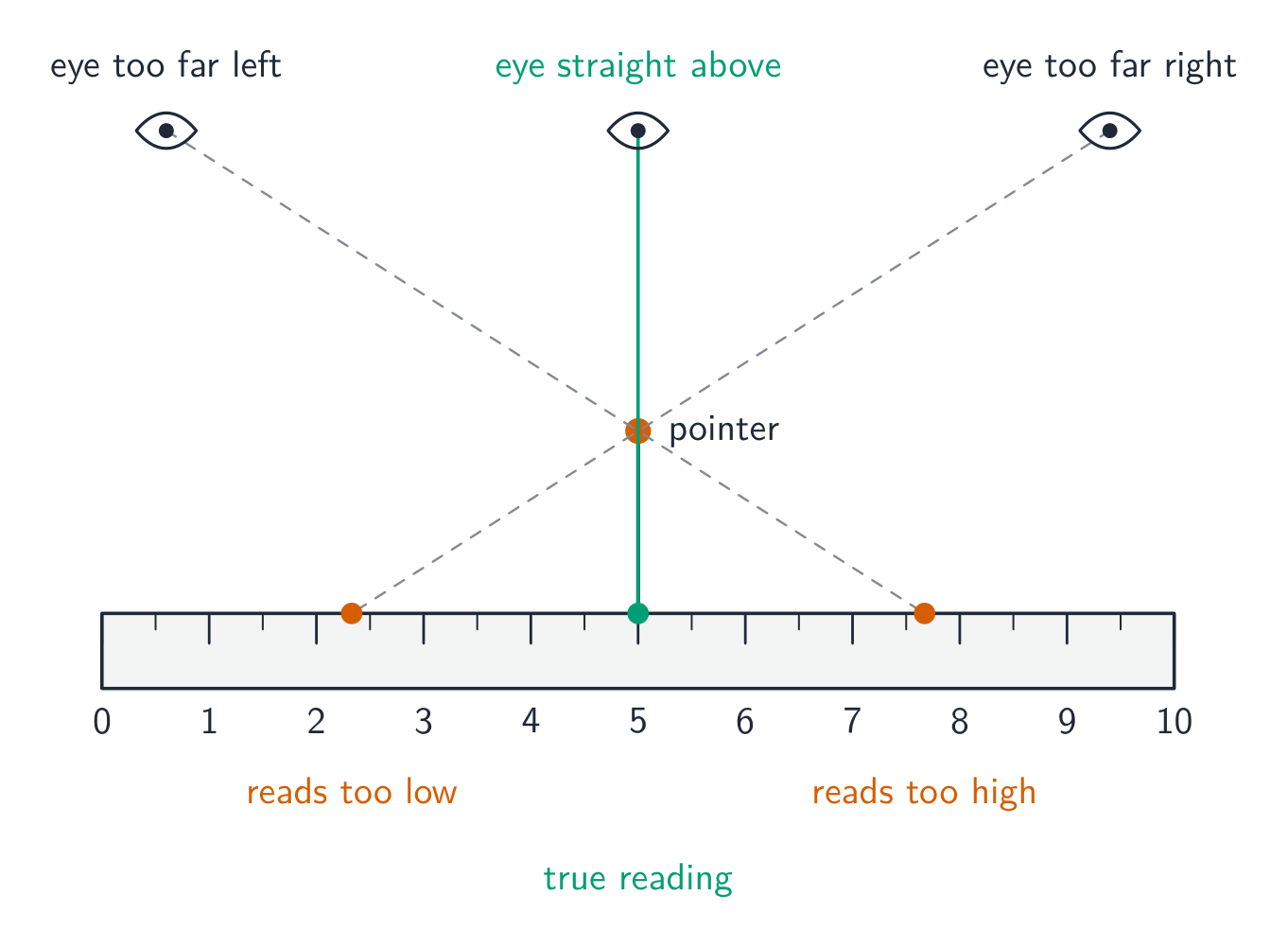
Parallax: viewing a scale from an angle shifts the reading — a systematic error
Which of these is a systematic error?
A zero error shifts every reading by the same amount in the same direction — that is systematic. The others vary randomly from reading to reading.
Random errors 随机误差
- A random error makes readings jump above and below, with no pattern.
- Repeat the measurement many times and take the mean — the scatter partly cancels.

Precision 精密度: how narrow the distribution is around the true value T
To reduce a random error, repeat the measurement and take the ____.
Random errors scatter both ways, so the mean of many repeats partly cancels them. (A systematic error survives averaging.)
Precision vs accuracy 准确度
- Precision = how tightly repeated readings cluster.
- Accuracy = how close they are to the true value.

Which error hurts which?
- A systematic error moves the whole cluster off-target → worse accuracy.
- A random error spreads the cluster out → worse precision.
Match each pattern of repeated readings to its description.
Precision is how tight the cluster is; accuracy is how near the true value (the bullseye) it sits.
Writing an uncertainty
- We write a result as $x \pm \Delta x$, where $\Delta x$ is the absolute uncertainty 绝对不确定度.
- The percentage uncertainty is $\dfrac{\Delta x}{|x|} \times 100\%$.
A length is $(20.0 \pm 0.5)\ \text{cm}$. What is its percentage uncertainty?
$\dfrac{\Delta x}{|x|} \times 100\% = \dfrac{0.5}{20.0} \times 100\% = 2.5\%$.
Combining: add or subtract
- If $y = a + b$ or $y = a - b$, add the absolute uncertainties.
- $\Delta y = \Delta a + \Delta b$.
Combining: multiply or divide
- If $y = \dfrac{a \cdot b}{c}$, add the percentage uncertainties.
- $\dfrac{\Delta y}{|y|} = \dfrac{\Delta a}{|a|} + \dfrac{\Delta b}{|b|} + \dfrac{\Delta c}{|c|}$.
For $y = \dfrac{a \cdot b}{c}$, how do you combine the uncertainties?
For multiplying and dividing, add the percentage uncertainties: $\dfrac{\Delta y}{|y|} = \dfrac{\Delta a}{|a|} + \dfrac{\Delta b}{|b|} + \dfrac{\Delta c}{|c|}$.
Combining: powers
- If $y = a^{n}$, multiply the percentage uncertainty by the power.
- $\dfrac{\Delta y}{|y|} = |n| \cdot \dfrac{\Delta a}{|a|}$.
A radius is measured with a $0.4\%$ uncertainty. A circle's area is $A = \pi r^{2}$. What is the percentage uncertainty in $A$?
For a power, multiply by the power: $A \propto r^{2}$, so the % uncertainty is $2 \times 0.4\% = 0.8\%$.
Worked example: volume of a ball
- Diameter $d = (5.26 \pm 0.02)\ \text{cm}$, and volume $V \propto d^{3}$.
- % uncertainty in $d$: $\dfrac{0.02}{5.26} \times 100\% \approx 0.38\%$.
- Power rule: % uncertainty in $V = 3 \times 0.38\% \approx 1.1\%$.
- So $V = (76.2 \pm 0.9)\ \text{cm}^{3}$.
Significant figures 有效数字
- Give an answer the same significant figures as the least precise measurement.
- Usually 2 or 3 in this course — too many makes it look more exact than it is.
You've got it
- systematic error → shifts every reading (worse accuracy); random → scatter (worse precision)
- repeat and take the mean to beat random error
- combine uncertainties: add absolute for $+\,-$, add % for $\times\,\div$, × the power for $a^{n}$