Work, energy and power
| English | Chinese | Pinyin |
|---|---|---|
| work done | 功 | gōng |
| displacement | 位移 | wèiyí |
| conservation of energy | 能量守恒 | néng liàng shǒu héng |
| efficiency | 效率 | xiào lǜ |
| thermal energy | 热能 | rè néng |
| power | 功率 | gōnglǜ |
Holding a bag does no work
- Hold a heavy bag still and your arm aches — but in physics you do zero work.
- Work needs the force to move something along its own direction.
- No movement (or a sideways force) means no work done 功.
Work done by a force
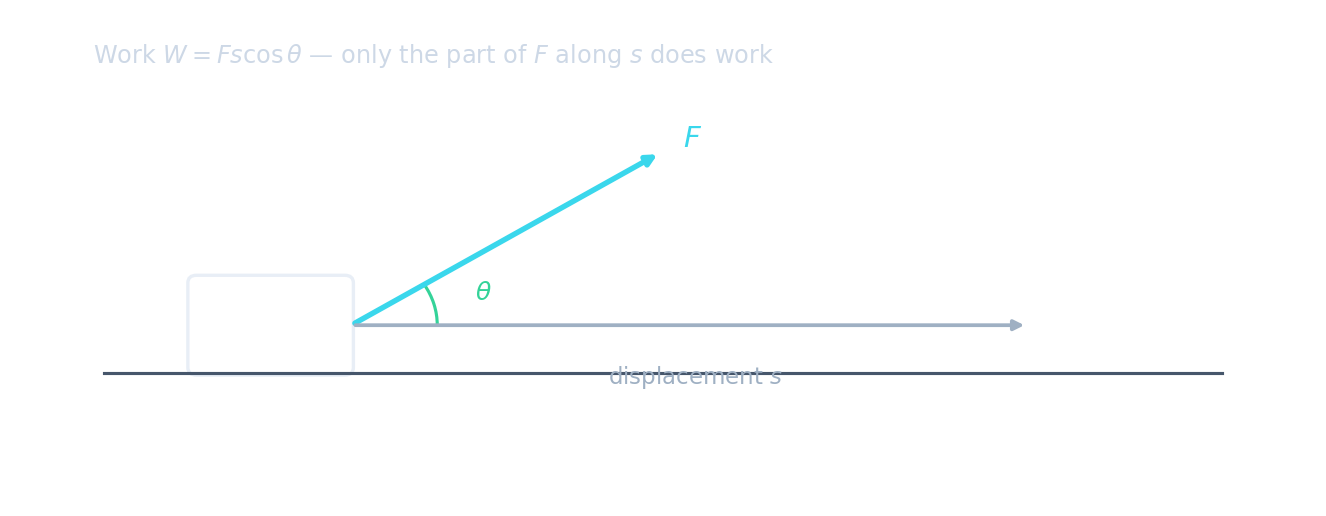
- $W = F s \cos\theta$, where $\theta$ is the angle between force and displacement 位移.
- Only the part of the force along the motion does work. Unit: $\text{J} = \text{N}\cdot\text{m}$.
Work, energy & power
PE + KE = constant
Work transfers energy; as it falls, PE becomes KE with the total fixed.
A force of $10\ \text{N}$ pushes a box $3.0\ \text{m}$ in the direction of the force. How much work is done?
Force is along the motion ($\theta = 0$), so $W = Fs = 10 \times 3.0 = 30\ \text{J}$.
Positive, negative, zero
- Force along the motion → positive work (energy given to the object).
- Force opposite the motion → negative work (e.g. friction takes energy away).
- Force at right angles → zero work.

Only the component F cos(theta) along the displacement does work
A force acting at right angles to the motion does how much work?
$W = Fs\cos 90^{\circ} = 0$. The normal contact force on a car on a flat road does no work.
Friction on a sliding object does negative work.
Friction points opposite to the motion ($\theta = 180^{\circ}$), so $W = -Fs$ — it takes energy away.
Conservation of energy 能量守恒
- Energy is never made or destroyed — it only changes form or moves between objects.
- In a closed system the total energy stays constant.

Positive work (force along motion) and negative work (force opposite motion)
Energy cannot be created or destroyed, only ____ from one form to another.
That is conservation of energy — the total in a closed system stays the same.
Efficiency 效率
- $\text{efficiency} = \dfrac{\text{useful output}}{\text{total input}} \times 100\%$.
- It is always below $100\%$ — some energy ends up as "useless" thermal energy 热能.

The same work done in less time means more power
Energy flow & efficiency
The input energy divides into useful work and wasted energy; efficiency = useful ÷ input, and useful + wasted always equals the input.
A machine takes in $200\ \text{J}$ and gives out $60\ \text{J}$ of useful energy. What is its efficiency (in %)?
$\dfrac{60}{200} \times 100\% = 30\%$. The other $140\ \text{J}$ is wasted, mostly as heat.
Power 功率
- Power is the rate of doing work: $P = \dfrac{W}{t} = \dfrac{\Delta E}{\Delta t}$.
- Unit: $\text{W} = \dfrac{\text{J}}{\text{s}}$.
Power, force and velocity
- For a force $F$ along the motion at speed $v$: $P = Fv$.
- A car at steady speed needs $P = F_{\text{resist}} \times v$; lifting a weight at speed $v$ needs $P = mgv$.
A force $F$ acts on an object moving at speed $v$ in the direction of the force. The power delivered is:
In time $\Delta t$ the displacement is $v\Delta t$ and the work is $Fv\Delta t$; dividing by $\Delta t$ gives $P = Fv$.
You've got it
- work $W = Fs\cos\theta$ — only the part of $F$ along the motion counts
- energy is conserved; efficiency = useful ÷ total (always < 100%)
- power $P = \dfrac{W}{t} = Fv$