Thermal equilibrium
| English | Chinese | Pinyin |
|---|---|---|
| heat | 热量 | rè liàng |
| thermal energy | 热能 | rè néng |
| thermal equilibrium | 热平衡 | rè píng héng |
| net flow | 净流动 | jìng liú dòng |
A spoon in hot soup
- Put a cold spoon in hot soup: the spoon warms, the soup cools — until they match.
- Energy moved from the hot thing to the cold thing.
- That one-way flow is the key idea of temperature.
Thermal equilibrium route
Watch energy transfer until two objects reach the same temperature.
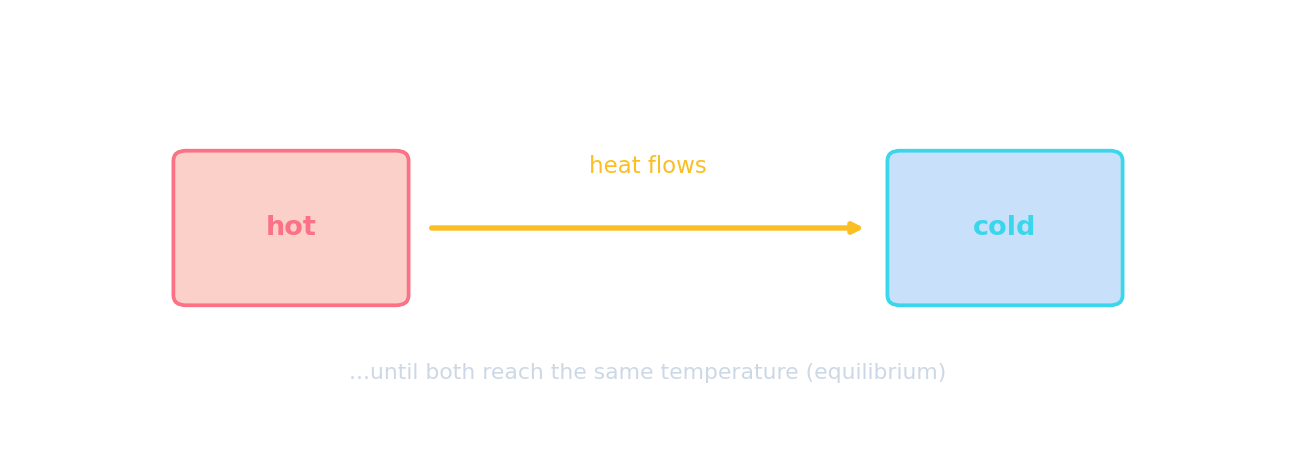
Heat 热量 flows hot to cold
- Heat (thermal energy 热能) flows from higher to lower temperature.
- It keeps flowing until the temperatures are equal.
Heat (thermal energy) naturally flows from:
Energy always flows down the temperature difference, from hot to cold, until they are equal.
Thermal equilibrium 热平衡
- When two things reach the same temperature, they are in thermal equilibrium.
- There is then no net flow 净流动 of energy between them.

A thermal (infrared) camera turns temperature into colour: the hot fries glow bright orange, while the cold drink stays dark
At thermal equilibrium there is no net flow of energy between two bodies.
Equal temperatures mean no net flow — particles still exchange energy, but with no overall transfer.
Two objects in thermal equilibrium are at the same ____.
Same temperature is exactly the condition for thermal equilibrium.
Temperature is not energy
- Temperature decides the direction of heat flow — not how much energy a body holds.
- A tiny spark at $1000\ °\text{C}$ holds far less energy than a warm swimming pool.

A constant-volume gas thermometer: gas pressure is read from the mercury height difference h
Temperature tells you:
Temperature decides the direction of heat flow; the amount of energy also depends on mass and material.
A hot spark always contains more thermal energy than a warm swimming pool.
No — the spark is at a higher temperature, but the huge pool holds far more thermal energy overall.
You've got it
- heat flows from higher to lower temperature
- thermal equilibrium: equal temperature, no net energy flow
- temperature sets the direction of flow, not the amount of energy