Kinetic theory of gases
| English | Chinese | Pinyin |
|---|---|---|
| kinetic theory | 分子动理论 | fèn zǐ dòng lǐ lùn |
| random motion | 无规则运动 | wú guī zé yùn dòng |
| elastic | 弹性 | tán xìng |
| mean-square speed | 均方速率 | jūn fāng sù lǜ |
| internal energy | 内能 | nèi néng |
Pressure from tiny drumbeats
- A gas pushes on its container because countless molecules keep hitting the walls.
- Kinetic theory 分子动理论 builds the big-scale gas laws from this tiny random motion 无规则运动.
- It even reveals what temperature really is.
The assumptions
- Many identical molecules in continuous random motion.
- Their own volume is negligible; forces between them are ignored except in collisions.
- Collisions are elastic 弹性, and Newton's laws apply.
Boyle's law
p ∝ 1/V
At constant temperature, pressure is inversely proportional to volume — squash the gas and the pressure rises.
Select all the assumptions of the kinetic theory of an ideal gas.
Forces between molecules are ignored except during (elastic) collisions — they do not attract strongly at all times.
Pressure of a gas
- Each wall bounce reverses a molecule's momentum, giving the wall a tiny push.
- Adding over all molecules gives $pV = \tfrac{1}{3}Nm\langle c^{2}\rangle$.
A gas exerts pressure on its container because the molecules:
Each collision pushes on the wall; the combined effect of countless collisions is the pressure.
Root-mean-square speed 均方速率
- $\langle c^{2}\rangle$ is the mean-square speed; its square root is the r.m.s. speed $c_{\text{r.m.s.}}$.
- A single useful measure of how fast the molecules move.

Molecules share out a range of speeds; raising the temperature shifts the whole spread to higher speeds
The r.m.s. speed is the square root of the ____ speed.
Take the mean of the squared speeds, then square-root it: $c_{\text{r.m.s.}} = \sqrt{\langle c^{2}\rangle}$.
Average kinetic energy
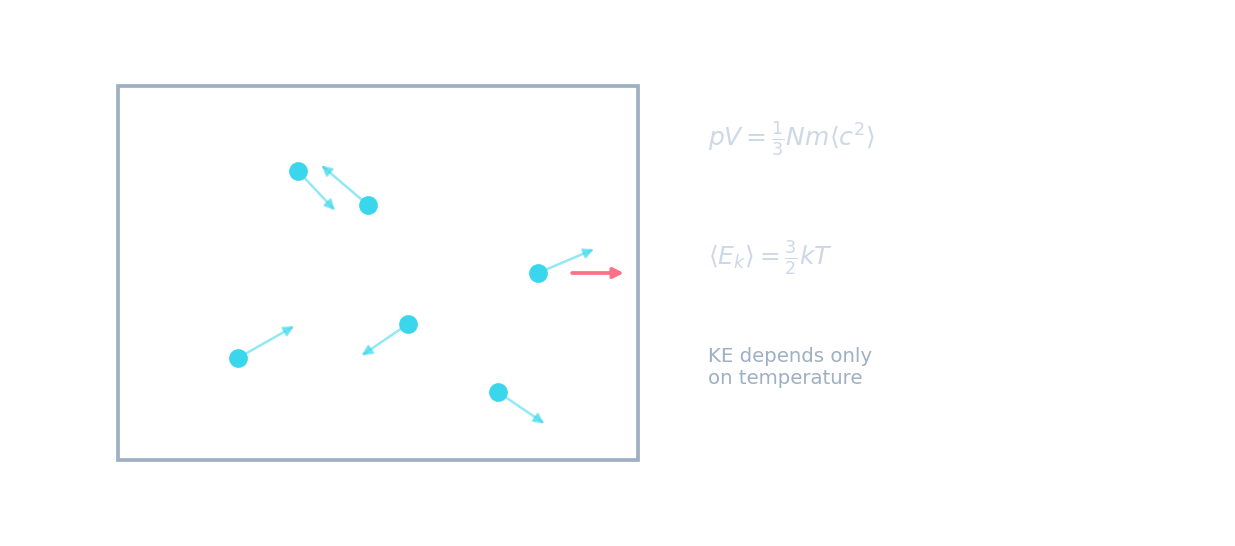
- Comparing $pV = NkT$ with $pV = \tfrac{1}{3}Nm\langle c^{2}\rangle$ gives $\tfrac{1}{2}m\langle c^{2}\rangle = \tfrac{3}{2}kT$.
- So the average KE depends only on temperature — double $T$, double the KE. Lighter molecules move faster at the same $T$.

Average molecular kinetic energy is proportional to absolute temperature: ½m⟨c²⟩ = (3/2)kT
The average translational kinetic energy of a gas molecule depends only on:
$\langle E_k\rangle = \tfrac{3}{2}kT$ — only the thermodynamic temperature matters.
If the absolute temperature doubles, the r.m.s. speed grows by a factor of:
$\langle c^{2}\rangle \propto T$, so $c_{\text{r.m.s.}} \propto \sqrt{T}$ — doubling $T$ multiplies it by $\sqrt{2} \approx 1.41$.
At the same temperature, lighter molecules move faster on average than heavier ones.
Same average KE $\tfrac{3}{2}kT$, but smaller mass means a larger $\langle c^{2}\rangle$ — so lighter molecules are faster.
Internal energy 内能
- An ideal gas's molecules have only kinetic energy (no forces between them).
- So its internal energy is $U = \tfrac{3}{2}NkT = \tfrac{3}{2}nRT$ — proportional to temperature.
The internal energy of an ideal gas equals:
Ideal-gas molecules have only kinetic energy, so $U = \tfrac{3}{2}NkT = \tfrac{3}{2}nRT$ — proportional to $T$.
You've got it
- kinetic theory: $pV = \tfrac{1}{3}Nm\langle c^{2}\rangle$ from random molecular motion
- average molecule KE $= \tfrac{1}{2}m\langle c^{2}\rangle = \tfrac{3}{2}kT$ — depends only on $T$
- internal energy of an ideal gas $U = \tfrac{3}{2}nRT$