Capacitors and capacitance
| English | Chinese | Pinyin |
|---|---|---|
| capacitor | 电容器 | diàn róng qì |
| insulator | 绝缘体 | jué yuán tǐ |
| capacitance | 电容 | diàn róng |
| farad | 法拉 | fǎ lā |
| parallel | 并联 | bìng lián |
| series | 串联 | chuàn lián |
Storing charge for a flash
- A camera flash charges a capacitor 电容器 slowly, then dumps it in a bright burst.
- A capacitor stores charge on two plates separated by an insulator 绝缘体.
- How much it holds is its capacitance 电容.
Capacitance
- Capacitance is the charge stored per unit p.d.: $C = \dfrac{Q}{V}$.
- More charge for the same voltage means a bigger capacitance.

A capacitor is two plates separated by an insulator; charge sits on the plates with a field between them
Capacitance
Q = C·V
Charge stored is proportional to voltage — the gradient is the capacitance C.
Capacitance is the charge stored per unit:
$C = \dfrac{Q}{V}$ — charge per volt, in farads.
A capacitor holds $0.012\ \text{C}$ at $4.0\ \text{V}$. What is its capacitance, in mF?
$C = \dfrac{Q}{V} = \dfrac{0.012}{4.0} = 0.0030\ \text{F} = 3.0\ \text{mF}$.
The farad 法拉
- Unit: the farad ($1\ \text{F} = 1\ \dfrac{\text{C}}{\text{V}}$) — a huge unit, so real ones are pF to mF.
- $C$ is constant for a given capacitor: double the charge and the voltage doubles too.
Doubling the charge on a capacitor doubles the voltage, so its capacitance stays the same.
$C = \dfrac{Q}{V}$ is fixed by the capacitor's size and dielectric — $Q$ and $V$ rise together.
Combining capacitors
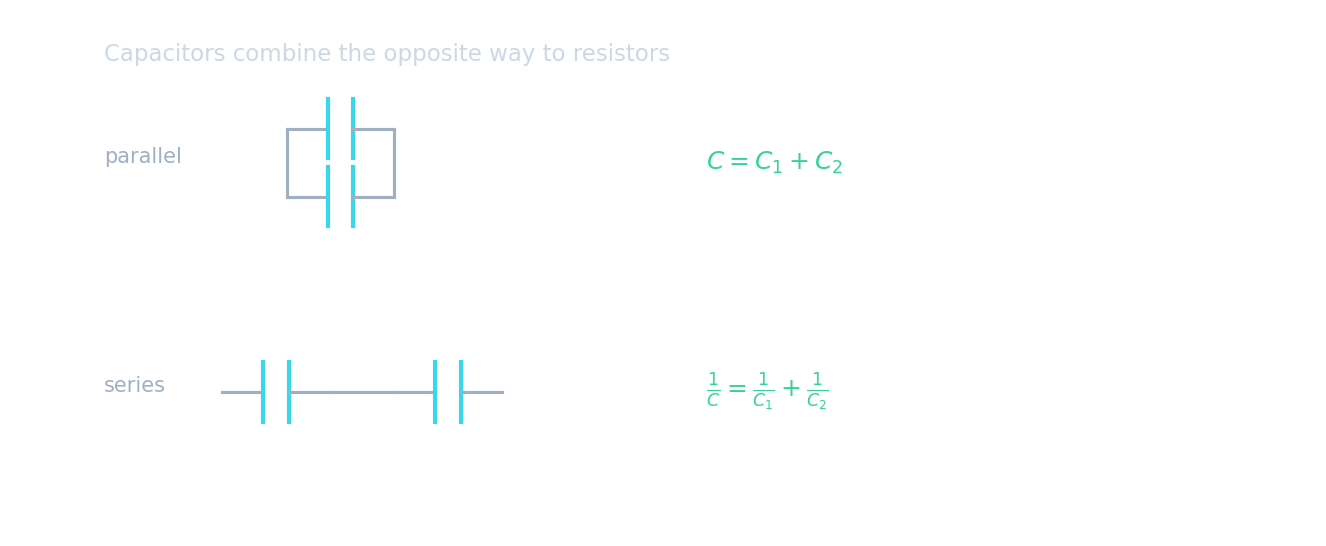
- Parallel: $C = C_1 + C_2$ — adds up to a bigger capacitance.
- Series 串联: $\dfrac{1}{C} = \dfrac{1}{C_1} + \dfrac{1}{C_2}$ — smaller. (Opposite to resistors!)
A $2.0\ \mu\text{F}$ and a $3.0\ \mu\text{F}$ capacitor are in parallel. What is the total capacitance, in µF?
In parallel capacitances add: $2.0 + 3.0 = 5.0\ \mu\text{F}$.
Two capacitors in parallel give a combined capacitance that is:
Parallel capacitors add ($C_1 + C_2$) — the opposite of resistors, which add in series.
You've got it
- capacitance $C = \dfrac{Q}{V}$, in farads (C/V) — constant for a given capacitor
- parallel capacitors add ($C_1 + C_2$); series use the reciprocal rule
- this is the opposite of how resistors combine