Mass defect and nuclear binding energy
| English | Chinese | Pinyin |
|---|---|---|
| mass-energy equivalence | 质能等价 | zhì néng děng jià |
| fission | 裂变 | liè biàn |
| mass defect | 质量亏损 | zhì liàng kuī sǔn |
| binding energy | 结合能 | jié hé néng |
| nucleon | 核子 | hé zǐ |
A pinch of mass, a flood of energy
- The Sun turns millions of tonnes of mass into energy every second.
- A tiny mass change can release an enormous amount of energy.
- The link is Einstein's famous equation.
Mass defect energy lab
E = delta m c^2
Change mass defect and see binding energy rise with E = mc^2.
Mass-energy equivalence 质能等价
- $E = mc^{2}$, so a mass change releases $\Delta E = c^{2}\Delta m$.
- Masses are tiny but $c^{2}$ is huge: a change of $1\ \text{u}$ matches about $931\ \text{MeV}$.
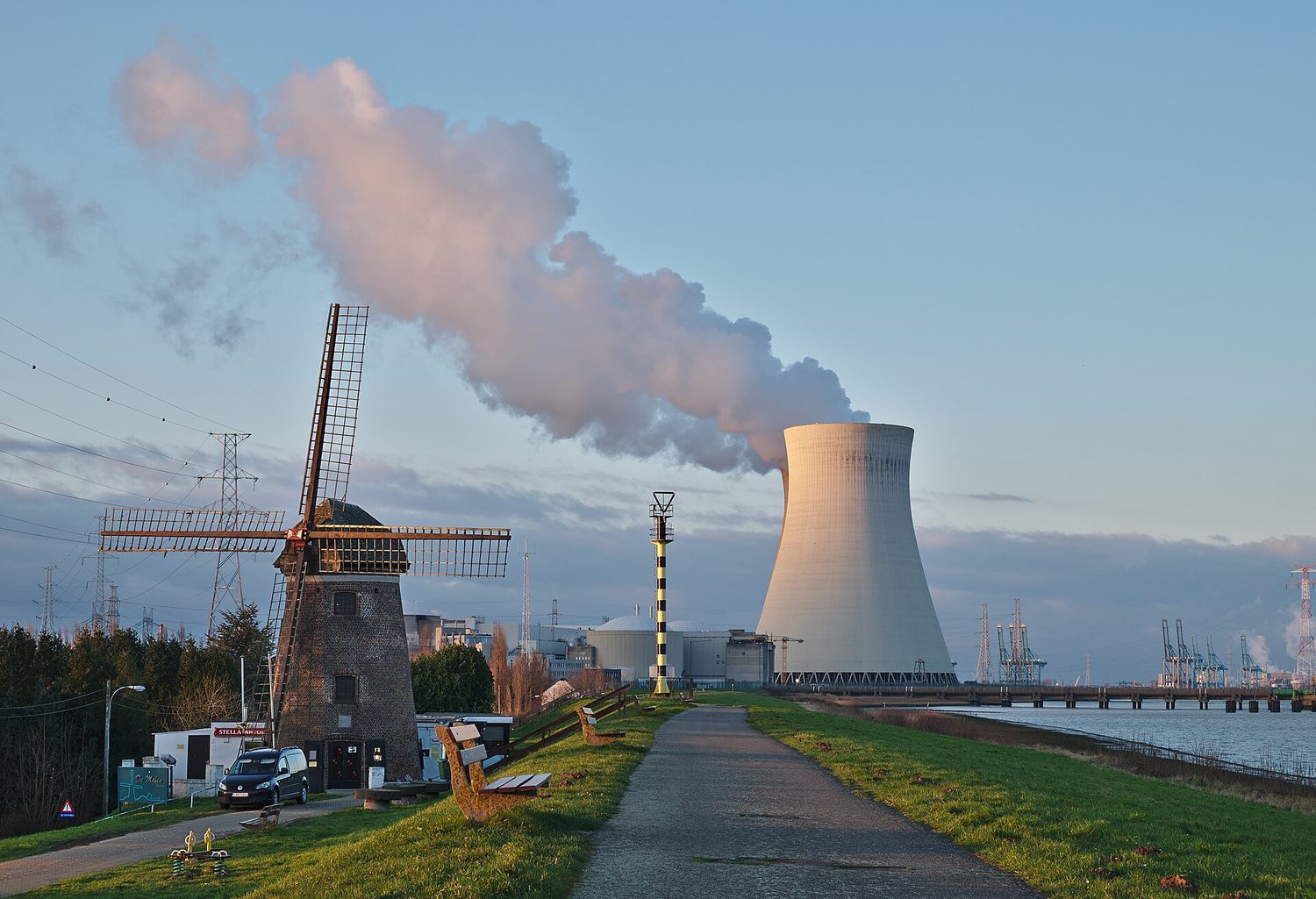
A nuclear power station releases energy by nuclear fission 裂变
The mass-energy relation is:
Mass and energy are equivalent: $E = mc^{2}$, so a mass change $\Delta m$ releases $c^{2}\Delta m$.
A mass change of $1\ \text{u}$ corresponds to about how many MeV?
$1\ \text{u} = 1.66 \times 10^{-27}\ \text{kg}$ gives $\Delta E = c^{2}\Delta m \approx 931\ \text{MeV}$.
Mass defect 质量亏损 and binding energy 结合能
- A nucleus has less mass than its separate protons and neutrons — the mass defect $\Delta m$.
- The energy to pull it fully apart is the binding energy $B = \Delta m\,c^{2}$.

The assembled nucleus is lighter than its separate nucleons — the missing mass is the binding energy

Binding energy per nucleon 核子 peaks near iron (A ~ 56); lighter and heavier nuclei are less tightly bound
A nucleus has ____ mass than its separate protons and neutrons added together.
That missing mass (the mass defect) was released as energy when the nucleus formed.
The binding energy is the energy needed to pull a nucleus completely apart.
$B = \Delta m\,c^{2}$ — the energy released on forming the nucleus, which must be returned to separate it.
Binding energy per nucleon
- $\dfrac{B}{A}$ measures how tightly each nucleon is held.
- The curve peaks near iron ($A \approx 56$, $\sim 8.8\ \text{MeV}$) — the most stable nucleus.

The binding energy per nucleon is greatest for:
Iron ($A \approx 56$) sits at the peak — the most tightly bound, most stable nucleus.
You've got it
- $E = mc^{2}$; a mass change of $1\ \text{u} \approx 931\ \text{MeV}$
- mass defect: nucleus mass < sum of parts; binding energy $B = \Delta m\,c^{2}$
- binding energy per nucleon peaks at iron — the most stable nucleus