Market research
| English | Chinese | Pinyin |
|---|---|---|
| market research | 市场调研 | shì chǎng diào yán |
| secondary research | 二手调研 | èr shǒu diào yán |
| primary research | 一手调研 | yī shǒu diào yán |
| questionnaires | 问卷 | wèn juǎn |
| quantitative | 定量 | dìng liàng |
| qualitative | 定性 | dìng xìng |
| sample | 样本 | yàng běn |
| representative | 有代表性的 | yǒu dài biǎo xìng de |
| biased | 有偏的 | yǒu piān de |
Asking before you act
- Launching a product on a guess is risky. Smart businesses find out what customers want first.
- That is market research 市场调研.
Market research cycle
Follow how a business turns customer data into a marketing decision.
Carrying out a new customer questionnaire is:
Primary research collects new first-hand data.
Using existing data from the internet is:
Secondary research uses data that already exists.
Primary vs secondary research 二手调研
- Primary research 一手调研: new data collected first-hand (surveys, interviews, questionnaires 问卷). Specific but costly.
- Secondary research: existing data (reports, internet, sales records). Cheap and fast, but not tailored.
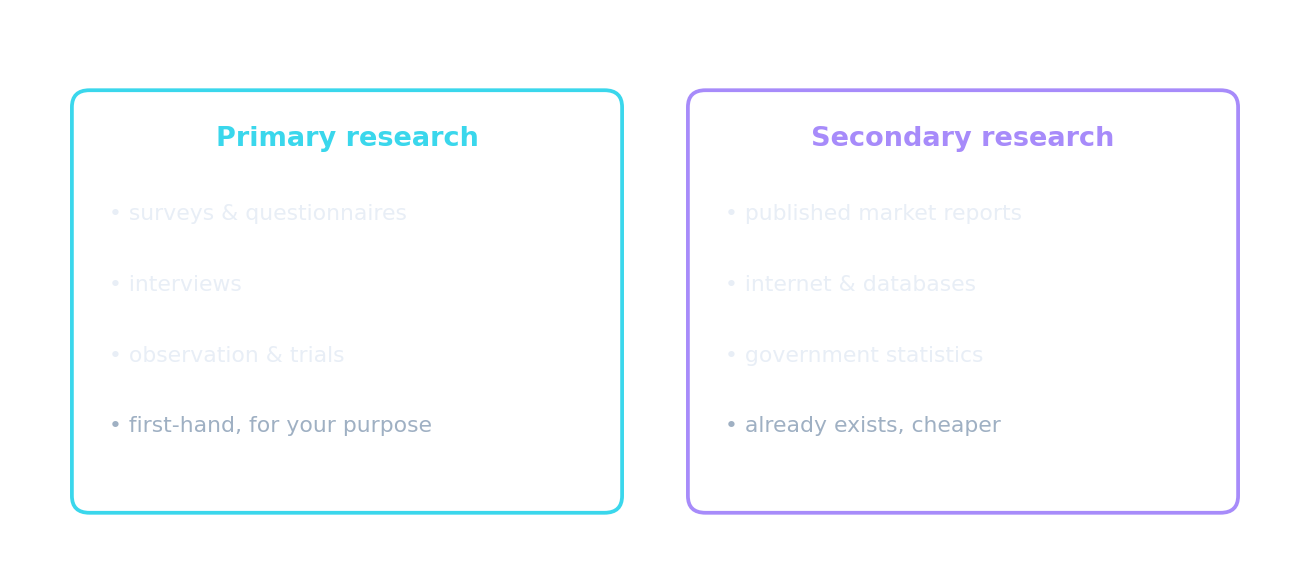
Market research: primary (first-hand) versus secondary (already exists)
Research that explores WHY customers feel as they do is:
Qualitative research captures opinions and reasons.
Quantitative 定量 vs qualitative 定性
- Quantitative: numbers — how many, how much.
- Qualitative: opinions and reasons — why customers behave as they do.

Primary research collects new data; secondary uses existing data
A small or biased sample can give misleading research results.
Sample quality affects reliability.
A small group chosen to represent the whole market is a ______.
Sampling avoids asking everyone.
Sampling 样本 and reliability
- A sample is a small group chosen to represent the whole market.
- A larger, more representative 有代表性的 sample gives more reliable results — but costs more.
Bad research misleads. If a sample is too small or not representative, or questions are biased 有偏的, the results can point a business the wrong way. Quality of research matters, not just quantity.
You've got it
- primary research = new first-hand data; secondary = existing data
- quantitative = numbers; qualitative = opinions and reasons
- a representative sample gives reliable results — design matters