Motion — speed, acceleration and graphs
| English | Chinese | Pinyin |
|---|---|---|
| speed | 速率 | sù lǜ |
| velocity | 速度 | sù dù |
| acceleration | 加速度 | jiā sù dù |
| deceleration | 减速 | jiǎn sù |
| gradient | 斜率 | xié lǜ |
| free fall | 自由落体 | zì yóu luò tǐ |
| air resistance | 空气阻力 | kōng qì zǔ lì |
| terminal velocity | 收尾速度 | shōu wěi sù dù |
How fast, and speeding 速率 up?
- A cheetah sprints at about $30\ \text{m/s}$; a passenger jet cruises near $250\ \text{m/s}$.
- Motion is about two ideas: how fast something goes, and how its speed changes.
- We describe both with simple formulas — and read them straight off graphs.
Speed and velocity 速度
- Speed is the distance travelled each second:
- Average speed uses the whole journey: $\dfrac{\text{total distance}}{\text{total time}}$.
- Velocity is speed in a stated direction — so velocity is a vector, speed is a scalar.

The shape of a distance-time line: flat = at rest, straight = constant speed, curve = speeding up
Speed, acceleration & graphs
v = u + at
On a speed–time graph the gradient is the acceleration and the area underneath is the distance travelled.
A runner covers $100\ \text{m}$ in $8.0\ \text{s}$. What is the average speed, in m/s?
$v = \dfrac{s}{t} = \dfrac{100}{8.0} = 12.5\ \text{m/s}$.
Acceleration 加速度
- Acceleration is how much the velocity changes each second:
- $\Delta v$ means "the change in velocity".
- Slowing down is a deceleration 减速 — a negative acceleration.
A car speeds up from rest to $20\ \text{m/s}$ in $4.0\ \text{s}$. What is its acceleration, in m/s²?
$a = \dfrac{\Delta v}{\Delta t} = \dfrac{20 - 0}{4.0} = 5.0\ \text{m/s}^2$.
Distance–time graphs
- A distance–time graph shows how far an object has gone.
- Flat line → the object is at rest.
- Straight slope → steady speed. The steeper the line, the faster it goes (the gradient 斜率 is the speed).
- Curve getting steeper → it is speeding up.
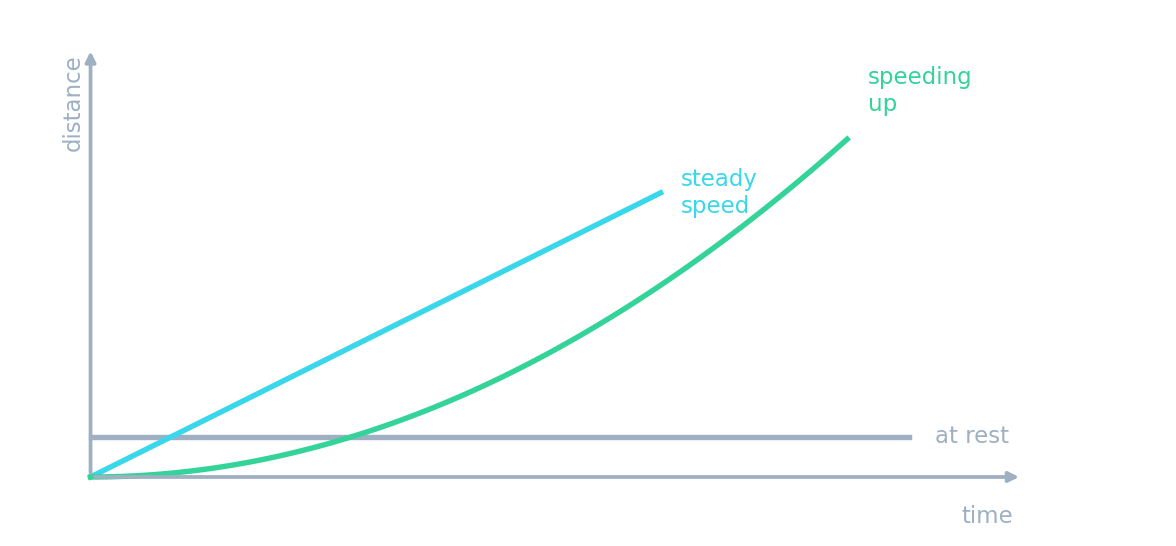
On a distance–time graph, a flat (horizontal) line means the object is:
A flat distance–time line means the distance is not changing — the object is at rest.
Speed–time graphs
- A speed–time graph shows how fast an object is going.
- Flat line → constant speed.
- Straight slope → constant acceleration (the gradient is the acceleration).
- Area under the line → the distance travelled.
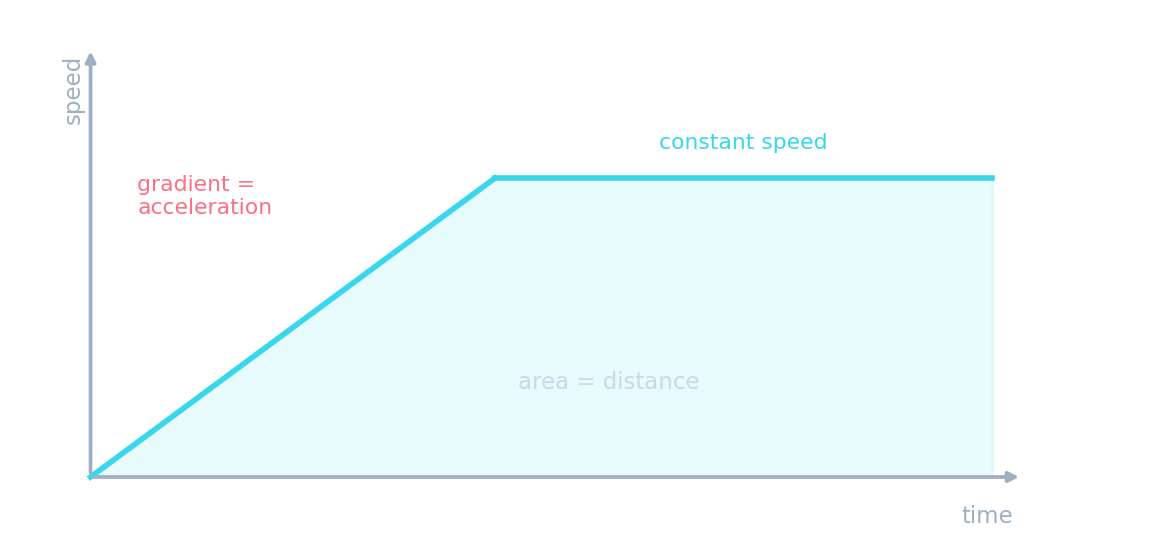
On a speed–time graph, the area under the line is the distance travelled.
Speed × time = distance, and that is exactly the area under a speed–time line.
A car travels at a constant $10\ \text{m/s}$ for $6.0\ \text{s}$. From the speed–time graph (area), how far does it go, in m?
The area is a rectangle: $10 \times 6.0 = 60\ \text{m}$.
Falling objects
- Near the Earth, all objects speed up as they fall at the same rate: the acceleration of free fall 自由落体, $g \approx 9.8\ \text{m/s}^2$.
- Falling through air, air resistance 空气阻力 pushes up and grows as the object speeds up.
- When air resistance equals the weight, the resultant force is zero — the object stops speeding up and falls at a steady terminal velocity 收尾速度.
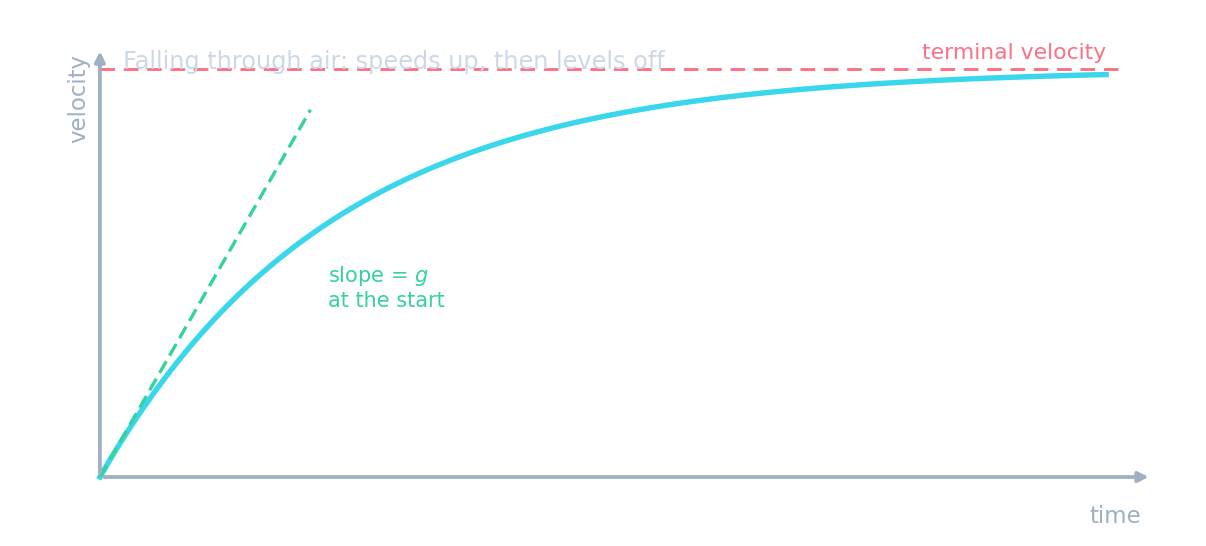
A skydiver reaches terminal velocity. This happens because:
As speed rises, air resistance grows until it balances the weight. The resultant force is then zero, so the speed stays steady.
You've got it
- speed $v = \dfrac{s}{t}$; velocity is speed with a direction
- acceleration $a = \dfrac{\Delta v}{\Delta t}$; slowing down is negative
- distance–time: gradient = speed · speed–time: gradient = acceleration, area = distance
- free fall: $g \approx 9.8\ \text{m/s}^2$; terminal velocity when air resistance = weight