Reflection and refraction
| English | Chinese | Pinyin |
|---|---|---|
| normal | 法线 | fǎ xiàn |
| angle of incidence | 入射角 | rù shè jiǎo |
| angle of reflection | 反射角 | fǎn shè jiǎo |
| virtual | 虚的 | xū de |
| refractive index | 折射率 | zhé shè lǜ |
| total internal reflection | 全反射 | quán fǎn shè |
| critical angle | 临界角 | lín jiè jiǎo |
| optical fibres | 光纤 | guāng xiān |
Bouncing and bending light
- A mirror bounces light back; a straw in a glass of water looks bent.
- These are reflection and refraction — the two basic things light does at a surface.
- We measure all angles from the normal 法线: a line at $90°$ to the surface.
Reflection
- The law of reflection: the angle of incidence 入射角 equals the angle of reflection 反射角 (both from the normal).
- A plane mirror makes an image that is: the same size, the same distance behind the mirror, and virtual 虚的 (it cannot be caught on a screen).
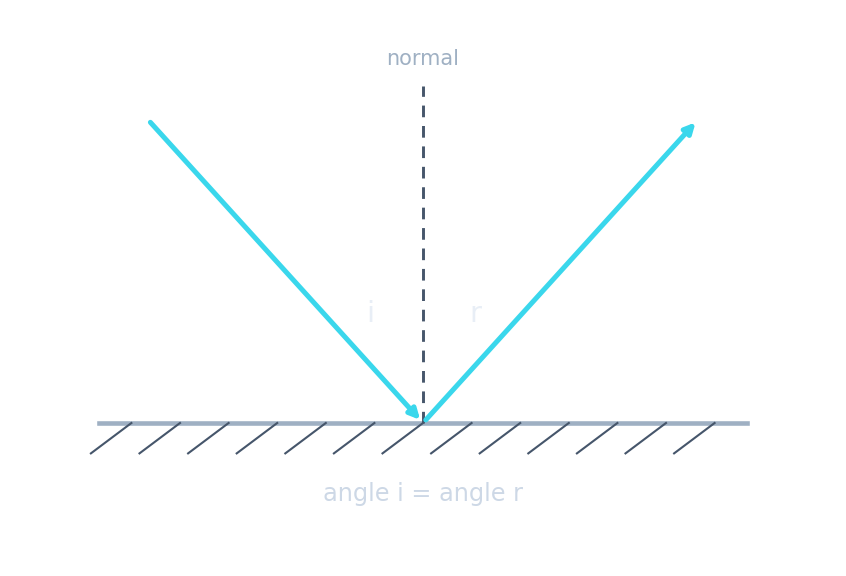

The law of reflection
Bend a light ray
Shine light into water, glass or diamond and change the angle. The ray slows and bends toward the normal — the denser the material (higher n), the more it bends. That bending is why a straw looks broken in a glass, and why diamonds sparkle.
A ray hits a plane mirror at $30°$ to the normal. At what angle to the normal does it reflect?
The law of reflection: the angle of reflection equals the angle of incidence, both measured from the normal.
An image in a plane mirror is:
A plane mirror gives a virtual image, the same size, the same distance behind the mirror — it cannot be caught on a screen.
Refraction
- When light passes into a new material it changes speed and bends.
- Going from air into glass, it slows down and bends toward the normal (so $i > r$).
- The refractive index 折射率 compares the bending:
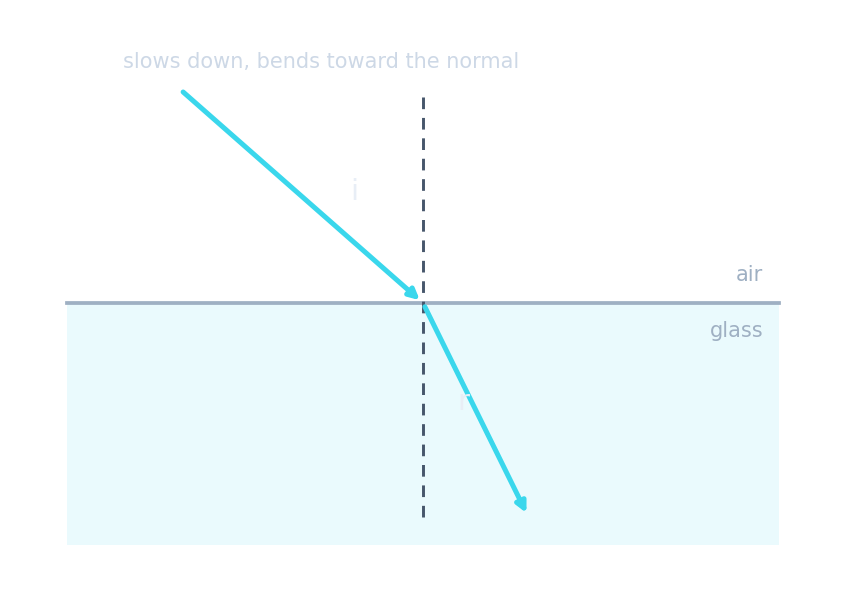
A ray of light passes from air into glass. It:
Light travels slower in glass, so going air → glass it bends toward the normal ($i > r$).
For light entering glass, $\sin i = 0.80$ and $\sin r = 0.50$. What is the refractive index?
$n = \dfrac{\sin i}{\sin r} = \dfrac{0.80}{0.50} = 1.6$.
Total internal reflection 全反射
- Light leaving glass bends away from the normal. Past a certain angle — the critical angle 临界角 $c$ — it cannot get out at all and reflects completely.
- This is total internal reflection, and it happens when the angle inside is bigger than $c$:
- It keeps light bouncing along optical fibres 光纤, the thin glass threads that carry internet and phone signals.
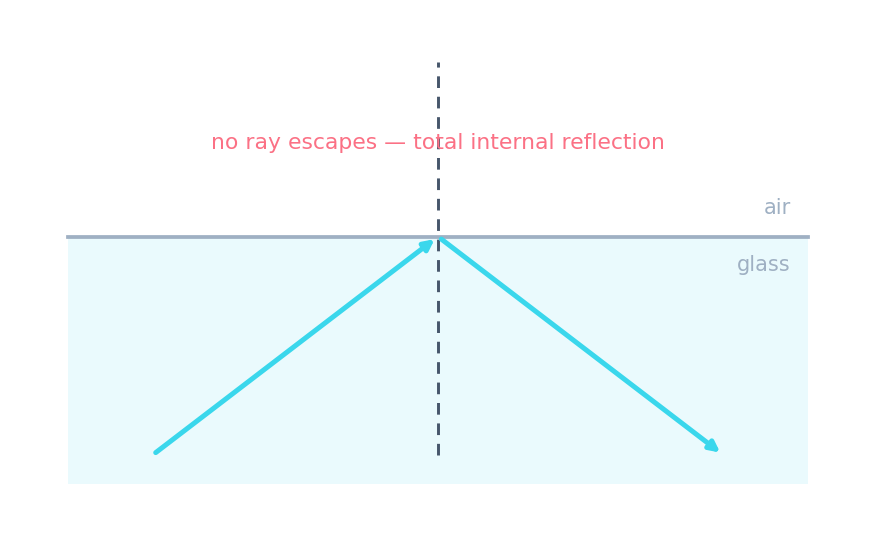

Total internal reflection keeps light bouncing along each optical fibre until it shines out at the tip
Total internal reflection happens when light inside glass hits the surface at an angle that is:
Above the critical angle the light cannot escape and is reflected completely back inside.
Optical fibres use total internal reflection to carry light signals.
Light bounces along the fibre by total internal reflection, carrying internet and phone signals over long distances.
You've got it
- measure angles from the normal; reflection: angle i = angle r
- a plane mirror image is virtual, same size, same distance behind
- refraction: into glass → slows, bends toward the normal; $n = \dfrac{\sin i}{\sin r}$
- past the critical angle, light is totally internally reflected (optical fibres)