Resistance, electrical energy and power
| English | Chinese | Pinyin |
|---|---|---|
| resistance | 电阻 | diàn zǔ |
| ohms | 欧姆 | ōu mǔ |
| filament lamp | 灯丝灯泡 | dēng sī dēng pào |
| diode | 二极管 | èr jí guǎn |
| fixed resistor | 定值电阻 | dìng zhí diàn zǔ |
| kilowatt-hour | 千瓦时 | qiān wǎ shí |
Slowing the flow
- Push current through a thin wire and it gets hot; through a thick one, less so.
- Resistance 电阻 measures how hard it is for current to flow.
- It controls the current, heats your toaster, and sets your electricity bill.
Resistance
- Resistance $R$ is measured in ohms 欧姆 ($\Omega$). A bigger resistance gives a smaller current:
- To measure it: an ammeter in series reads $I$, a voltmeter across the component reads $V$, then divide.

A pylon carries the cables that bring electricity at very high voltage
Resistance
V = R·I
Ohm's law: voltage is proportional to current — the gradient is the resistance R.
A component has $12\ \text{V}$ across it and a current of $3.0\ \text{A}$ through it. What is its resistance, in Ω?
$R = \dfrac{V}{I} = \dfrac{12}{3.0} = 4.0\ \Omega$.
What changes a wire's resistance
- A longer wire has more resistance — resistance is proportional to length ($R \propto l$).
- A thicker wire has less resistance — resistance is inversely proportional to the cross-sectional area ($R \propto \tfrac{1}{A}$).
- So doubling the length doubles $R$; doubling the area halves it.

I-V graphs for a resistor, a filament lamp 灯丝灯泡 and a diode 二极管
I–V characteristics
A resistor gives a straight line; a filament lamp and a diode do not. Pick a component and read I and R off the curve.
A wire is made twice as long (same thickness). Its resistance:
Resistance is proportional to length, so doubling the length doubles the resistance.
Match each electrical relationship to its formula.
Each item links the term to its correct meaning.
Current–voltage graphs
- A fixed resistor 定值电阻: a straight line through the origin — resistance is constant, so $I \propto V$.
- A filament lamp: an S-shape that gets flatter — the wire heats up, so its resistance rises.
- A diode: current one way only — very high resistance the "wrong" way.
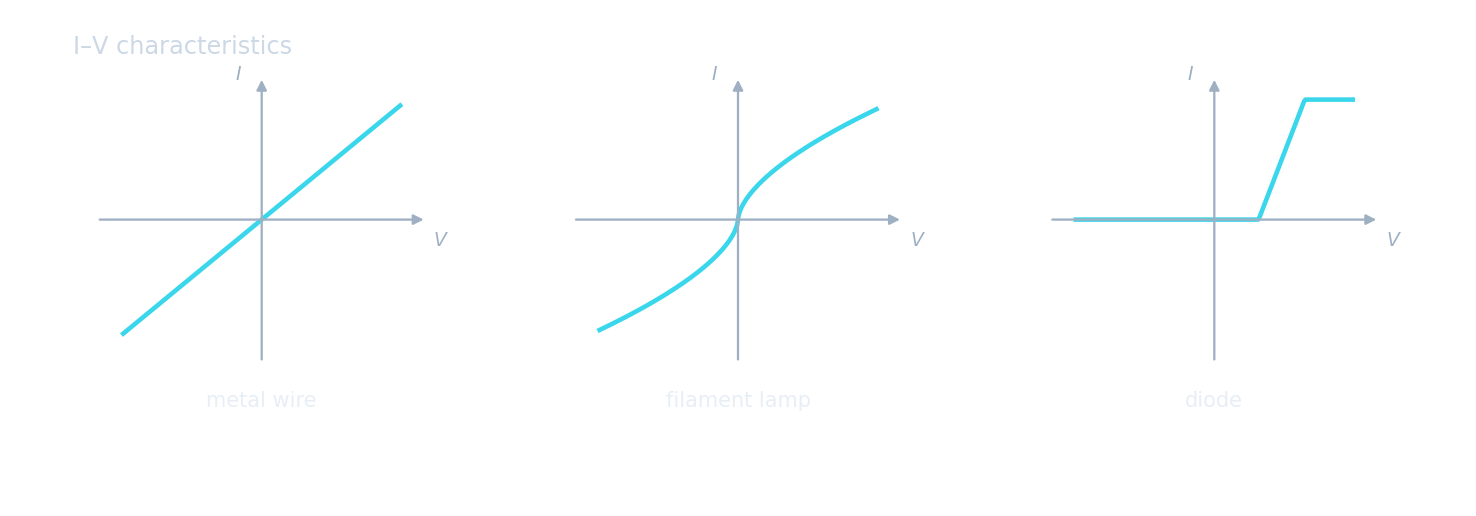
The I–V graph of a fixed resistor (at constant temperature) is:
A fixed resistor has constant resistance, so $I \propto V$ — a straight line through the origin.
Electrical power and energy
- Power is the energy transferred each second, in watts (W):
- The energy transferred in a time $t$, in joules (J), is:
A device runs at $12\ \text{V}$ and draws $2.0\ \text{A}$. What is its power, in W?
$P = IV = 2.0 \times 12 = 24\ \text{W}$.
The kilowatt-hour 千瓦时
- Electricity bills use a bigger unit, the kilowatt-hour (kWh): the energy a $1\ \text{kW}$ appliance uses in $1$ hour.
- Example: a $2\ \text{kW}$ heater for $3$ hours uses $6\ \text{kWh}$.
A $2.0\ \text{kW}$ heater is on for $3.0$ hours. How much energy does it use, in kWh?
energy = power × time = $2.0 \times 3.0 = 6.0\ \text{kWh}$.
If one kWh costs $20$ cents, what does $6.0\ \text{kWh}$ cost, in cents?
cost = energy × price = $6.0 \times 20 = 120$ cents.
You've got it
- $R = \dfrac{V}{I}$ (ohms); longer wire → more $R$, thicker wire → less $R$
- I–V graphs: resistor = straight line; lamp = S-curve (heats up); diode = one way
- power $P = IV$ (watts); energy $E = IVt$ (joules)
- kWh = power (kW) × time (h); cost = kWh × price