The ideal gas equation
| English | Chinese | Pinyin |
|---|---|---|
| equation of state | 状态方程 | zhuàng tài fāng chéng |
| kelvin | 开尔文 | kāi'ěrwén |
| pressure law | 气体压强定律 | qì tǐ yā qiáng dìng lǜ |
| ideal gas | 理想气体 | lǐ xiǎng qì tǐ |
One equation for a gas
- A balloon shrinks in the cold, swells in the heat, and pops when squeezed.
- Pressure, volume and temperature are all linked.
- One equation ties them together: $pV = nRT$.
The equation of state 状态方程
- $pV = nRT$ (using moles) or $pV = NkT$ (using molecules).
- $R = 8.31\ \dfrac{\text{J}}{\text{mol}\cdot\text{K}}$, $k = 1.38 \times 10^{-23}\ \dfrac{\text{J}}{\text{K}}$, with $k = \dfrac{R}{N_{\text{A}}}$. Always use kelvin 开尔文.

A scuba diver breathes compressed gas; pressure, volume and temperature are all linked
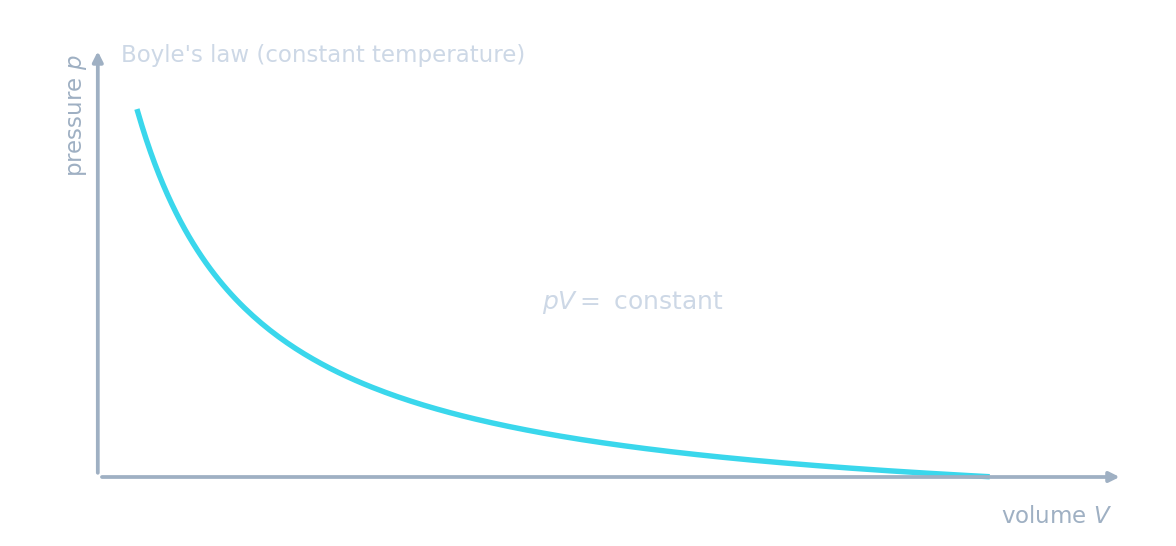
The ideal gas (Boyle)
p = k / V
At constant temperature p ∝ 1/V — squeeze the volume and pressure rises.
The equation of state of an ideal gas is:
$pV = nRT$ (moles) or $pV = NkT$ (molecules) — with $T$ in kelvin.
You may use temperature in °C in the ideal gas equation.
No — $pV \propto T$ only with $T$ in kelvin. Convert °C to K first.
The Boltzmann constant equals $R / N_{\text{A}}$ — the gas constant per molecule.
Since $N = n N_{\text{A}}$, comparing $pV = nRT$ with $pV = NkT$ gives $k = \dfrac{R}{N_{\text{A}}}$.
Changing state
- For a fixed amount of gas: $\dfrac{p_1 V_1}{T_1} = \dfrac{p_2 V_2}{T_2}$.
- Plug in two states and solve for the missing one (in SI units).

At constant pressure the volume of a gas rises linearly with temperature, reaching zero at absolute zero (Charles's law)
A gas at $200\ \text{kPa}$ and $300\ \text{K}$ is heated to $600\ \text{K}$ at constant volume. What is the new pressure?
At constant volume $\dfrac{p}{T}$ is constant: $p_2 = 200 \times \dfrac{600}{300} = 400\ \text{kPa}$.
Three special cases
- Boyle (constant $T$): $pV =$ constant.
- Charles (constant $p$): $\dfrac{V}{T} =$ constant.
- Pressure law 气体压强定律 (constant $V$): $\dfrac{p}{T} =$ constant.

Compressed gas cylinders store a fixed mass of gas at high pressure
At constant temperature, a gas at $100\ \text{kPa}$ is squeezed to half its volume. What is the new pressure?
Boyle: $pV$ is constant, so halving $V$ doubles $p$ → $200\ \text{kPa}$.
At constant pressure, $V$ divided by $T$ stays ____.
That is Charles's law: $\dfrac{V}{T} =$ constant at fixed pressure.
You've got it
- ideal gas 理想气体: $pV = nRT = NkT$ — temperature in kelvin
- a fixed amount: $\dfrac{p_1 V_1}{T_1} = \dfrac{p_2 V_2}{T_2}$
- Boyle ($pV$ const), Charles ($V/T$ const), pressure law ($p/T$ const)