Specialised cells and organisation
| English | Chinese | Pinyin |
|---|---|---|
| tissues | 组织 | zǔ zhī |
| organs | 器官 | qì guān |
| organ systems | 器官系统 | qì guān xì tǒng |
| specialised cells | 特化细胞 | tè huà xì bāo |
| haemoglobin | 血红蛋白 | xuè hóng dàn bái |
| ciliated | 有纤毛的 | yǒu xiān máo de |
From one cell to a whole body
- A single cell can't run a whole organism. Bodies are built up in levels.
- And cells aren't all the same — many are specialised for one job.
Cell organisation lab
See how cells build tissues, organs and systems.
Put the levels of organisation in order from smallest to largest.
Cells → tissues → organs → organ systems → organism.
A group of similar cells working together is a:
A tissue is a group of similar cells.
Several different tissues working together form an ______.
An organ is made of several tissues.
Levels of organisation
- Cells → tissues 组织 → organs 器官 → organ systems 器官系统 → organism.
- A tissue is a group of similar cells; an organ is several tissues working together.

Cells build up into tissues, organs, organ systems and the whole organism
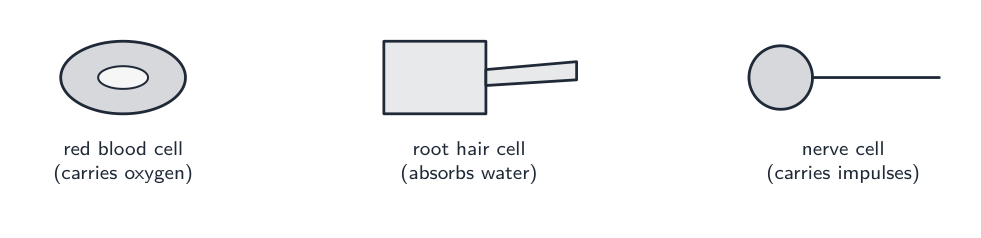
Specialised cells have shapes that suit their jobs
A red blood cell is specialised to carry oxygen. It has:
No nucleus leaves more room for haemoglobin, which carries oxygen.
Specialised cells 特化细胞
- Red blood cells: no nucleus, full of haemoglobin 血红蛋白 — carry oxygen.
- Root hair cells: long extension — absorb water and minerals.
- Nerve cells: long and thin — carry electrical signals.

A light microscope, used to look at cells
A root hair cell's long shape gives it a large surface area for absorbing water.
Its structure fits its function of absorption.
Structure fits function
- Each specialised cell's shape and parts suit its job.
- For example, a sperm cell has a tail to swim; a ciliated 有纤毛的 cell has tiny hairs to sweep mucus.
Worked example. A root hair cell has a long, thin extension. This gives a large surface area to absorb water and minerals quickly — a perfect match of structure to function.

A bacterial cell has no nucleus: its DNA is a single loop, plus small plasmids
You've got it
- organisation: cells → tissues → organs → organ systems → organism
- specialised cells (red blood, root hair, nerve) each do one job
- a cell's structure fits its function (e.g. root hair's large surface area)