How DNA makes proteins
| English | Chinese | Pinyin |
|---|---|---|
| bases | 碱基 | jiǎn jī |
| double helix | 双螺旋 | shuāng luó xuán |
| base sequence | 碱基序列 | jiǎn jī xù liè |
| amino acid | 氨基酸 | ān jī suān |
Reading the genetic code
- DNA holds a code — but how does that code actually build a protein?
- The answer lies in DNA's elegant structure and the order of its bases 碱基.
The shape of a DNA molecule is a:
DNA is a double helix — two twisted strands.
The structure of DNA
- DNA is a double helix 双螺旋: two strands twisted together.
- The strands are linked by pairs of bases, like rungs on a twisted ladder.

DNA is two strands held together by paired bases — a twisted ladder.
From gene to protein
Step through the central dogma: the DNA template is transcribed into mRNA by base pairing (A→U, T→A, G→C, C→G), then read in codons and translated into a chain of amino acids.
In DNA, base A always pairs with:
A pairs with T; C pairs with G.
The order of bases in a gene determines the protein made.
Base order sets the amino acid order, hence the protein.
In DNA, base C always pairs with base ______.
C-G and A-T are the base pairs.
The base sequence 碱基序列
- There are four bases (A, T, C, G), and they pair up: A with T, C with G.
- The order of bases along a gene is the code.
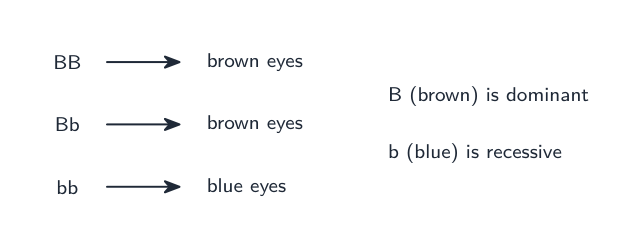
A dominant allele shows with one copy; a recessive needs two
How many bases code for one amino acid?
A triplet of three bases codes for one amino acid.
From code to protein
- Each group of three bases codes for one amino acid 氨基酸.
- The order of bases sets the order of amino acids, which determines the protein made.
Worked example. A gene's base sequence is copied and read three bases at a time. Each triplet adds one amino acid to a growing chain. The finished chain folds into a specific protein — say, an enzyme.
You've got it
- DNA is a double helix of two strands joined by base pairs
- bases pair A-T and C-G; the order of bases is the code
- every three bases code for one amino acid, building a protein