Living standards
| English | Chinese | Pinyin |
|---|---|---|
| GDP per head | 人均GDP | rén jūn GDP |
| GDP | 国内生产总值 | guó nèi shēng chǎn zǒng zhí |
| living standards | 生活水平 | shēng huó shuǐ píng |
| Human Development Index | 人类发展指数 | rén lèi fā zhǎn zhǐ shù |
| life expectancy | 预期寿命 | yù qī shòu mìng |
| inequality | 不平等 | bù píng děng |
| informal economy | 非正规经济 | fēi zhèng guī jīng jì |
How well-off is a country?
- We sense that some countries are richer than others — but how do you actually measure it?
- Economists use a country's output per person as the starting point.
Economics case lab
Classify real examples by the economic idea they show.
GDP per head is calculated as:
GDP per head = total output ÷ population.
GDP per head is also called GDP per ______.
Per capita means per person.
GDP per head 人均GDP
- GDP 国内生产总值 = the total value of goods and services a country produces in a year.
- GDP per head (per capita) = GDP ÷ population — a rough measure of average income and living standards 生活水平.

Absolute poverty: in informal settlements many people lack basic needs such as safe housing, clean water and sanitation
Which does the HDI include? (Select all that apply.)
The HDI combines income, education and health.
The HDI gives a fuller picture of living standards than income alone.
It adds health and education to income.
A wider picture: the HDI
- Income alone misses a lot. The Human Development Index 人类发展指数 (HDI) combines three things:
- income (GNI per head), education (years of schooling), and health (life expectancy 预期寿命).
Worked example. Two countries have the same GDP per head, but one has far better schools and longer life expectancy. The HDI ranks that one higher — capturing what income alone misses.
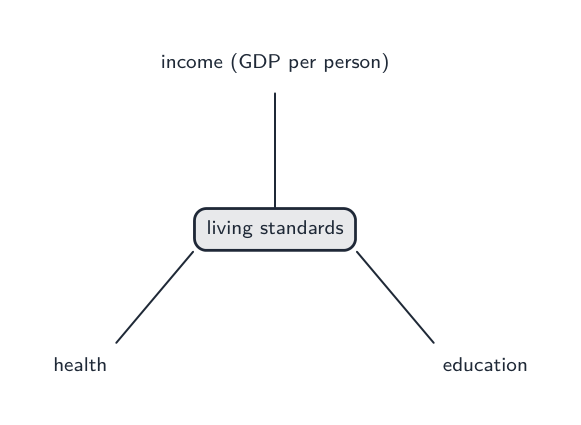
Living standards depend on income, health and education
A weakness of GDP per head as a welfare measure is that it:
An average can hide large differences between rich and poor.
Why the measures fall short
- GDP per head is an average — it hides inequality 不平等.
- It ignores unpaid work, the environment, leisure, and the informal economy 非正规经济.
A higher average doesn't mean everyone is better off. GDP per head can rise while most people see nothing if the gains go to a small group. Always ask how income is distributed.
You've got it
- GDP per head = output ÷ population — a basic living-standards measure
- the HDI adds education and health to income for a fuller picture
- averages hide inequality and miss unpaid work and the environment