Current, e.m.f. and potential difference
| English | Chinese | Pinyin |
|---|---|---|
| electric current | 电流 | diàn liú |
| potential difference | 电势差 | diàn shì chà |
| amperes | 安培 | ān péi |
| ammeter | 电流表 | diàn liú biǎo |
| conventional current | 常规电流 | cháng guī diàn liú |
| direct current | 直流电 | zhí liú diàn |
| alternating current | 交流电 | jiāo liú diàn |
| volts | 伏特 | fú tè |
| voltmeter | 电压表 | diàn yā biǎo |
What is flowing?
- Switch on a lamp and something flows through the wires — an electric current 电流.
- A cell gives that flow the push it needs.
- Three quantities describe it all: current, e.m.f. and potential difference 电势差.
Electric current
- An electric current is a flow of electric charge, measured in amperes 安培 (A) with an ammeter 电流表 joined in series.
- Current is the charge passing a point each second:
- $I$ in amperes, $Q$ in coulombs (C), $t$ in seconds.
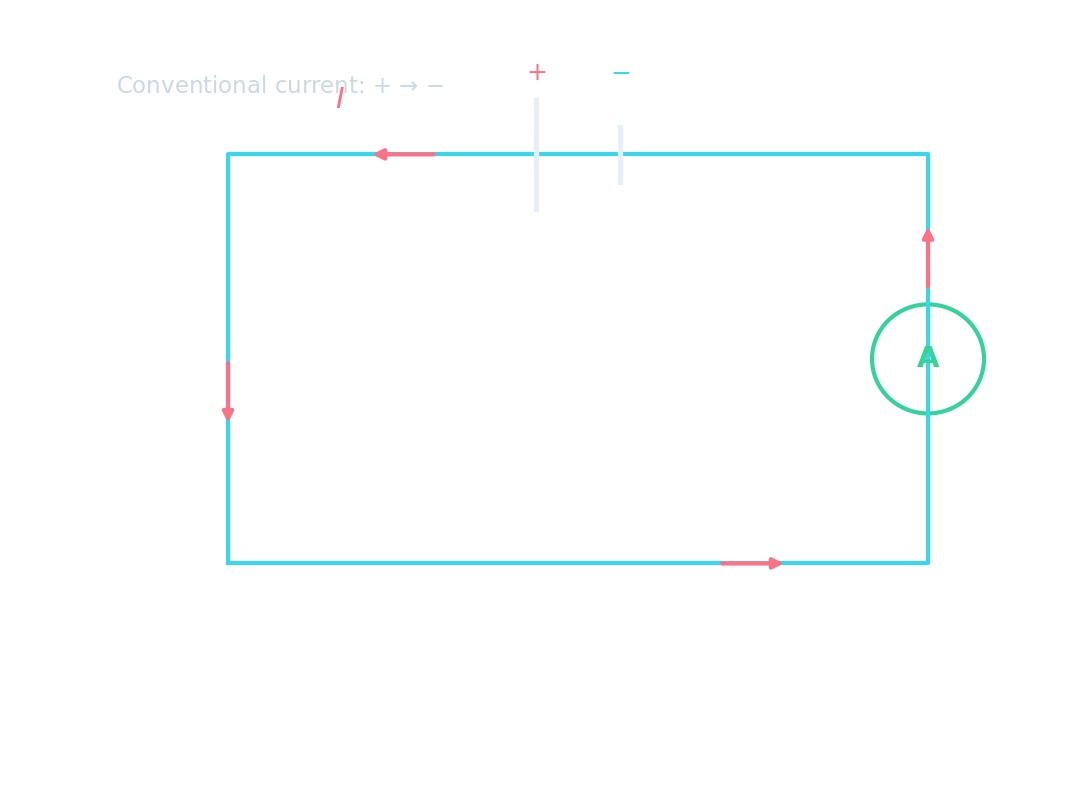
Conventional current 常规电流 flows from the positive terminal to the negative terminal, through the external circuit. The ammeter (A) is connected in series to measure the current.
Worked example. A current of $2\ \text{A}$ flows for $30\ \text{s}$. Charge $= It = 2 \times 30 = 60\ \text{C}$.
Conventional current vs electron flow. Conventional current is drawn from $+$ to $-$, but the actual electrons in a metal wire drift the opposite way ($-$ to $+$). The convention was set before electrons were discovered, and we still use it today.
Ohm's law
V = IR
For an ohmic conductor the current is proportional to the voltage — the gradient is 1/resistance.
A charge of $30\ \text{C}$ flows past a point in $10\ \text{s}$. What is the current, in A?
$I = \dfrac{Q}{t} = \dfrac{30}{10} = 3.0\ \text{A}$.
A current of $2.0\ \text{A}$ flows for $5.0\ \text{s}$. How much charge passes, in C?
$Q = It = 2.0 \times 5.0 = 10\ \text{C}$.
How is an ammeter connected to measure the current through a lamp?
An ammeter goes in series so the same current flows through it and the lamp. (A voltmeter goes in parallel.)
Direction and type of current
- Conventional current flows from + to − round the outside of the cell.
- The free electrons in a metal really drift the other way (− to +).
- Direct current 直流电 (d.c.) always flows one way (a battery). Alternating current 交流电 (a.c.) keeps swapping direction (the mains).

Direct current is steady in one direction; alternating current keeps swapping direction, crossing zero many times each second

Resistors, components that control the current in a circuit
Conventional current flows around the outside of a cell from:
Conventional current is taken from + to −. The electrons themselves drift the opposite way (− to +).
E.m.f. and potential difference
- Both are measured in volts 伏特 (V) and both are work done per unit charge:
- e.m.f. is the energy a source gives each coulomb to drive it round the whole circuit.
- potential difference (p.d.) is the energy each coulomb gives up in one component.
- A voltmeter 电压表 measures them, joined in parallel (across the component).
A cell does $120\ \text{J}$ of work driving $60\ \text{C}$ of charge round a circuit. What is its e.m.f., in V?
$E = \dfrac{W}{Q} = \dfrac{120}{60} = 2.0\ \text{V}$.
A voltmeter is connected:
A voltmeter measures the p.d. across a component, so it is connected in parallel with it.
Match each electrical quantity to its meaning.
Each item links the term to its correct meaning.
You've got it
- current = flow of charge: $I = \dfrac{Q}{t}$; ammeter in series, in amperes
- conventional current + → −; electrons drift − → +; d.c. one way, a.c. swaps
- e.m.f. (whole circuit) and p.d. (one component) are both $\dfrac{W}{Q}$ in volts
- voltmeter in parallel